
Glue-Free Cabinet Construction: How It Works and Why It Matters
A specification guide explaining glue free cabinet construction, how it differs from low-emission composite board, and why architects use adhesive-free formed cabinet bodies in wet, high-value rooms.
Direct answer
The Direct Answer
Glue free cabinet construction matters because it removes adhesive-dependent composite-board carcasses from the cabinet-body specification. A low-emission panel can still be a glued panel, while a mechanically formed 304 stainless steel cabinet body changes both the moisture-risk profile and the indoor-air conversation. In wet, heavily used rooms, that structural difference is often more important than the marketing label on the sample door.
What is glue-free cabinet construction, and why does it matter?
Glue-free cabinet construction is a cabinet system that forms the body mechanically and finishes surfaces without adhesive-dependent composite-board carcasses. In practical terms, that means the cabinet box is no longer defined by glued panel edges, laminated cores, or board joints that have to survive years of steam, splashes, cleaning chemicals, and swelling pressure.
That distinction matters because buyers often treat emissions labels and cabinet structure as the same conversation when they are not. A compliant low-emission panel is still a panel-based cabinet body. Glue free cabinet construction moves the decision upstream: instead of asking only how much formaldehyde a glued board may release, you ask whether the structural cabinet body still relies on glue-bound composite board in the first place. For wet, heavily used rooms, that structural distinction usually matters more over fifteen years than the marketing language on day one.
EPA says the most significant sources of formaldehyde in homes are often pressed wood products made using urea-formaldehyde resins, and cabinets are one of the common indoor examples. That is why the best specification discussion starts with body construction, not with a showroom phrase like “low emission” in isolation. The goal is to decide whether you want a better glue system or fewer glue-dependent structural parts.
- TSCA Title VI
- TSCA Title VI is the U.S. federal formaldehyde rule for regulated composite wood products such as hardwood plywood, particleboard, and MDF used in finished goods including cabinets.
Why are glued cabinet bodies still a specification risk even when they are compliant?
Compliance is real and valuable. It filters out worse products and creates a testing, labeling, and recordkeeping framework that the market needs. But a compliant glued cabinet body still accepts the long-term realities of panel construction: edges, joins, seal breaks, wet cleaning, under-sink leaks, and localized swelling risk. In other words, compliance tells you the panel stayed within a measured emissions threshold. It does not mean the cabinet body stopped being a board-based box.
This is where spec writing often gets lazy. The conversation stops at “CARB compliant” or “TSCA compliant,” as if those labels settle every durability and indoor-air question. EPA’s own indoor-air guidance draws the sharper line: pressed wood products made with urea-formaldehyde resins are likely the most significant formaldehyde sources in homes, and the examples it lists include particleboard shelving, hardwood plywood used in cabinets, and MDF drawer fronts and furniture tops. That guidance does not say all board products are equal, but it does remind specifiers that the chemistry and the construction are still there.
For buyers who plan to hold a home for a decade or more, the better question is not simply whether the panel passed the rule. The better question is whether the cabinet body still depends on glued board as the structural starting point, especially in kitchens, prep zones, vanities, and laundry rooms where moisture and cleaning frequency punish weak edges first.
- NAF resin
- NAF means no-added-formaldehyde-based resin, an EPA and CARB designation for qualifying panel systems that can receive testing and certification exemptions when approved conditions are maintained.
- ULEF resin
- ULEF means ultra-low-emitting-formaldehyde resin, an EPA and CARB category for panel systems that emit at very low levels and may qualify for reduced regulatory burdens when verified by approved certifiers.
| Question | Standard composite-board cabinet body | NAF or ULEF panel cabinet body | Glue-free formed cabinet body |
|---|---|---|---|
| Where is the structural chemistry? | In adhesive-bound plywood, particleboard, or MDF panels that make up the cabinet body. | Still in a panel system, but with exempt or reduced-emission resin chemistry documented under EPA and CARB rules. | The cabinet body is formed mechanically, so the core box no longer depends on glue-bound composite board. |
| What does compliance prove? | That the panel can meet the applicable emissions limit when tested by the rule. | That the panel qualified for a no-added or ultra-low-emitting exemption while the operation and resin system stayed approved. | That the cabinet body removes the panel adhesive question from the carcass and shifts verification to forming, coating, and assembly details. |
| What usually fails first in wet use? | Swelling, delamination, edge fatigue, and finish breakdown at repeatedly stressed seams. | Better emissions paperwork, but the cabinet body can still behave like a panel-based box when water reaches vulnerable edges. | The weak point is less about glue lines and more about whether the formed body, coating, and installation were specified correctly. |
| What should the buyer ask for? | Panel certification, edge details, moisture barriers, warranty exclusions, and service history. | The exact NAF or ULEF basis, validity period, and which parts of the finished good still rely on adhesive assembly. | Body-forming method, coating process, proof of adhesive-free structure, wet-zone detailing, and maintenance guidance. |
How is glue-free construction different from NAF or ULEF board?
NAF and ULEF are still panel-world categories. They matter because they reduce regulatory burden for approved products and acknowledge lower-emitting resin systems. EPA says those exemptions can apply when a panel producer has the right approval and continues to maintain the documented operation, process, and resin system. CARB says manufacturers of ULEF products that qualify can reduce testing frequency, and both EPA and CARB frame the exemption window in two-year approval cycles that must be maintained.
Glue free cabinet construction makes a different move. It does not merely substitute a better resin inside the same basic cabinet-body logic. It changes the logic of the body itself. If the carcass is formed from 304 stainless steel sheet, bent into shape, and finished without relying on glued composite board for the structural box, then the cabinet body has stepped outside the usual discussion about which panel chemistry is least problematic.
That distinction is why this topic belongs in a specification guide instead of a lifestyle article. Architects are not choosing between two slogans. They are choosing between two structural systems: one that still begins with adhesive-bound board, and one that uses mechanical forming and dry finishing to remove the glue line from the cabinet body. The room may look equally calm in the showroom, but the maintenance path is not the same.
How does an adhesive-free cabinet body stay rigid without glue lines?
In Fadior’s system, the answer is not decorative language but manufacturing method. The company’s own intelligence file describes a one-piece cabinet body formed from 304 stainless steel sheet through laser cutting and multi-hole bending on Salvagnini equipment, with no seams, no joints, and no visible welds in the finished body. The same file states that 88% of tracked components require bending, while welding applies to 47.5% of components, which tells you the body logic is fundamentally about formed geometry rather than glued lamination.
The finishing logic is equally important. Fadior’s glue-free process replaces structural adhesive dependency with imported PET film and dry powder electrostatic spray bonded at 220°C, and the process is covered by 12 patents tied to glue-free manufacturing. That is the kind of detail that changes procurement conversations. You are no longer asking only for a panel certificate. You are asking how the shell is formed, how the finish is bonded, how moisture-sensitive seams are avoided, and which parts of the system still remain optional accessories rather than structural necessities.
This is also why factory scale matters. A 600 million RMB smart-factory investment, more than 80,000 square meters of production area, and 20,000-plus units of monthly output do not prove quality by themselves, but they do indicate that the adhesive-free claim is attached to a repeatable industrial method rather than a one-off workshop experiment.
Why does maintenance become a different conversation when the cabinet body is glue-free?
Maintenance is where abstract engineering turns into monthly life. A cabinet body that depends on glued board asks the owner to protect every vulnerable edge forever: avoid standing water, avoid hidden leaks, avoid steam pockets, avoid cleaning habits that break finish seams, and hope the supplier’s exclusions stay theoretical. A formed cabinet body does not eliminate care, but it moves the maintenance conversation toward surface cleaning, drainage, and finish stewardship rather than toward swelling control and seam anxiety.
worldstainless describes the logic clearly in its consumer-facing maintenance guidance. The organization says stainless steel can last for more than 100 years, provided it is cleaned appropriately, and it frames care as a routine cleanliness task rather than a fight against the material itself. That does not mean every kitchen will be maintenance free. It means the maintenance task becomes easier to understand: remove dirt, grease, scale, and residue before they build up, instead of worrying that ordinary damp use is slowly attacking the structural heart of the cabinet body.
This matters commercially because owners live with maintenance scripts longer than they remember sales promises. When the cabinet body is adhesive-free, the supplier can defend the system with a more coherent aftercare story. When the body is still a glued board box, the supplier often has to lean harder on disclaimers about misuse, standing water, or room conditions that the client assumed were ordinary from the start.
Which rooms and climates expose glue-line weakness fastest?
The first stress test is not dramatic. It is repetitive. Steam from cooking, wipedown moisture around sinks, detergent residue, under-sink condensation, kettle splash, and daily heat cycles slowly punish vulnerable edges. In a dry guest room, that may take years to show. In a primary kitchen, back kitchen, laundry room, or vanity zone, the same weaknesses show up faster because the room is effectively a maintenance lab that runs every day.
Coastal and tropical homes raise the stakes, but they are not the only reason to care. A city apartment with serious daily cooking can be just as demanding if the owner wants quiet, cleanable, hygienic cabinet bodies that will not become a repair project after ordinary use. worldstainless says stainless steel can last for more than 100 years and, in its building-sector guidance, that it can offer at least 110 years of operational life with zero or minimal maintenance when correctly specified. That does not make every cabinet immortal, but it does explain why a formed corrosion-resistant body is fundamentally different from a board box whose long-term risks sit at the edges.
The sustainability argument is secondary but still useful. worldstainless also says stainless steel is 100% recyclable and reports manufacturing recycled content of 75%+ in Europe and the USA, 31% in China, and 60% elsewhere. For a buyer planning long ownership, it means the durability story and the circularity story reinforce each other rather than pulling in opposite directions.
| Room or condition | Why adhesive-dependent cabinet bodies are stressed | Why glue-free formed bodies help | What to verify before approval |
|---|---|---|---|
| Primary kitchens | Steam, splashes, detergent wipe-downs, and heat cycles keep working on edges and seams. | The cabinet body no longer relies on glue-bound board at the core of the wettest room in the house. | Check body-forming method, surface process, and how sink and appliance zones are detailed. |
| Prep kitchens and service pantries | Heavy-duty use hides behind closed doors, so unnoticed moisture and chemical exposure accumulate. | A formed cabinet shell is easier to wipe, easier to keep hygienic, and less vulnerable to hidden swelling. | Confirm interior layout, utility access, and what materials remain in shelves, backs, or accessories. |
| Laundry and vanity zones | Leaks, splashes, humidity spikes, and stored chemicals punish low-grade edges. | The structure stays closer to a formed shell instead of a moisture-sensitive board box. | Review under-sink detailing, toe-kick transitions, and the surface warranty language. |
| Long-hold waterfront or tropical homes | Salt-laden air, cleaning frequency, and high humidity expose every weak finish and seam. | The case for formed corrosion-resistant bodies gets stronger when the room will live through years of aggressive maintenance. | Verify the actual alloy, finish, cleaning guidance, and whether the supplier avoids unsupported grade claims. |
Why do procurement conversations keep confusing emissions paperwork with cabinet-body engineering?
Procurement language collapses because samples are seductive. A buyer sees a beautiful door finish, hears “CARB compliant” or “zero formaldehyde,” and assumes the cabinet body underneath has already been solved. But those are different layers of information. A finish sample tells you how the room may look. A panel certificate tells you something about regulated emissions from covered composite wood products. Neither one, by itself, fully explains how the structural cabinet body is made.
This confusion gets worse when suppliers mix panel language, room-performance language, and wellness language into a single sentence. “Low emission,” “clean,” “waterproof,” and “luxury” can all be true in some limited way while still leaving the cabinet body unresolved. That is why a specification guide has to slow the conversation down. It has to separate the visible finish from the structural shell, the panel chemistry from the body material, and the warranty headline from the maintenance burden that will actually show up five years later.
In practice, the simplest test is to ask the supplier to describe the cabinet body without using marketing adjectives. If the answer becomes precise very quickly, you are dealing with a system. If the answer becomes vaguer the more specific your questions become, then the project probably still depends on showroom language more than on engineering language.
When is glue-free construction worth specifying, and when is it not?
It is worth specifying when the client is buying for the room’s real duty cycle rather than for a first impression. Kitchens that see serious cooking, service pantries that hide the mess, vanity and laundry zones that live with water, and waterfront or tropical homes that amplify maintenance pressure all benefit from reducing the number of glue-dependent structural decisions. The case becomes even stronger when the client cares about indoor-air clarity, hygienic wipe-down performance, and a cabinet body that ages more like equipment than like decorative boardwork.
It is not the automatic answer for every budget and every room. A low-use dry room, a short-hold property, or a project whose design language depends on another material system may not need a fully glue-free cabinet body. The point of this article is not to pretend there is one universal answer. The point is to stop collapsing three different choices into one label: compliant panel construction, exempt low-emission panel construction, and truly adhesive-free formed-body construction. Once those are separated, clients can decide on performance instead of marketing mood.
Verification checklist before you approve the cabinet package
- Ask what the cabinet body is actually made from, not just what the visible finish looks like.
- If any plywood, particleboard, or MDF remains in the package, ask for the exact TSCA Title VI or CARB evidence for those components.
- Request a written explanation of whether the structural cabinet body relies on glued composite board, mechanical forming, or both.
- Confirm how the finish is bonded, including whether the system uses dry powder electrostatic spray and what process temperature is specified.
- Check wet-zone detailing at sinks, plinths, service pantries, vanities, and laundry areas where ordinary moisture reveals weak construction fastest.
- Read the warranty exclusions line by line so you know whether swelling, delamination, aggressive cleaning, or environmental exposure move the risk back to the owner.
Frequently Asked Questions
Questions this guide answers
- Does glue-free mean the entire kitchen contains no chemistry at all?
- No. Glue free cabinet construction means the structural cabinet body does not depend on glued composite board. Finishes, sealants, gaskets, and accessory parts still need to be disclosed honestly. The right reading is not “nothing chemical exists.” The right reading is that the core box no longer starts with adhesive-bound panel construction.
- Is a TSCA Title VI compliant cabinet the same thing as a glue-free cabinet?
- No. TSCA Title VI compliance proves that regulated composite wood products stayed within formaldehyde rules. It does not automatically tell you whether the cabinet body is still a panel-based box. Glue-free construction is a structural claim about how the body is formed, while TSCA compliance is a regulatory claim about emissions from covered panel products.
- If a supplier says the panels are NAF or ULEF, is that good enough?
- It is better than treating all board products as equal, but it is not the same as removing glue-dependent structure from the cabinet body. NAF and ULEF describe qualifying panel systems and exemptions. If the room is moisture-heavy or long-hold, buyers should still ask whether the carcass itself relies on glued composite board.
- Which rooms benefit most from glue-free cabinet construction?
- Primary kitchens, prep kitchens, vanities, laundry rooms, and humid or waterfront homes benefit the most because they combine water, heat, cleaning frequency, and heavy daily use. Those conditions expose edge swelling and seam fatigue faster than a dry, lightly used room would.
- What is the single most important proof to request from a supplier?
- Ask for a clear structural explanation of the cabinet body. If the answer quickly slides back to a finish sample or a generic emissions certificate, the conversation is incomplete. A serious supplier should be able to explain the body material, forming method, finish process, and which remaining components still fall under panel-emissions rules.
Related reading
Continue exploring the journal.
More guides, whitepapers, and insights from the Fadior journal.
Buyer's Guide
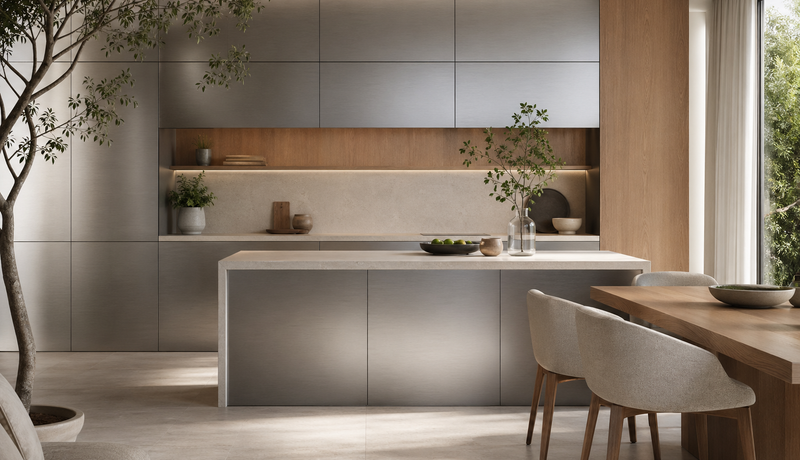
Zero-Formaldehyde Cabinetry: What the Label Really Means
A buyer-first guide to zero-formaldehyde cabinetry that explains what EPA and CARB rules cover, where adhesive chemistry still hides, and how to verify a truly glue-free cabinet system.
Technical Whitepaper
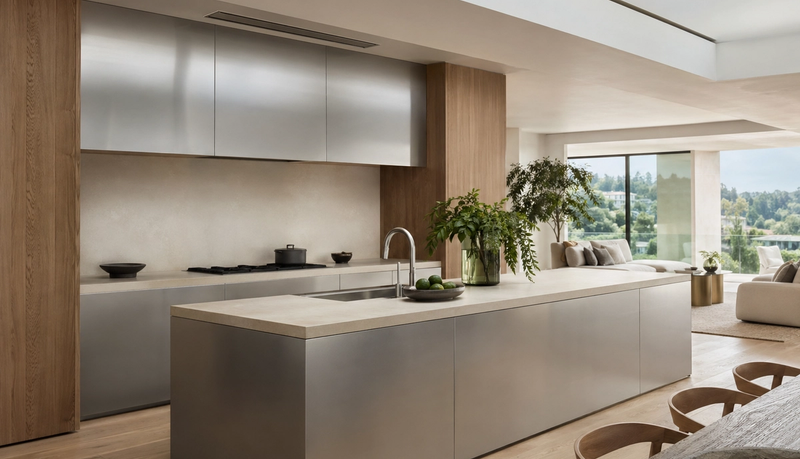
Kitchen Ventilation Specification for Luxury Open-Plan Homes
A specification guide for luxury kitchen ventilation that explains capture, CFM, downdraft tradeoffs, noise control, makeup air, and why open-plan homes need more than a decorative hood choice.
Buyer's Guide
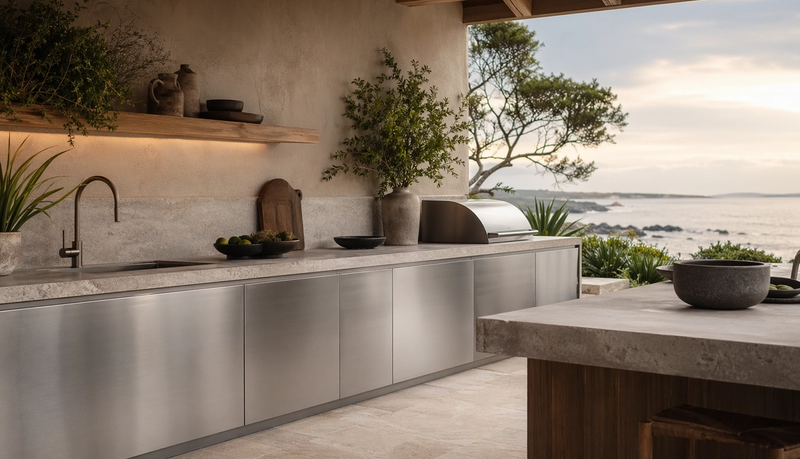
Outdoor Kitchen Cabinets for Coastal and Humid Climates
Compare coastal outdoor kitchen materials for salt air, humidity, maintenance, powder-coated aluminum, and 304 stainless steel cabinetry.
Related products
Specific products worth reviewing next.
References
Authoritative sources cited in this article
- EPA indoor air formaldehyde guidance
EPA indoor-air guidance says pressed wood products made with urea-formaldehyde resins are likely the most significant formaldehyde sources in homes, and it names cabinetry among the common examples.
United States Environmental Protection Agency
- EPA TSCA Title VI stakeholder FAQ
EPA lists TSCA Title VI emission limits of 0.05 ppm for hardwood plywood, 0.09 ppm for particleboard, 0.11 ppm for MDF, and 0.13 ppm for thin MDF.
United States Environmental Protection Agency
- EPA composite wood formaldehyde standards overview
EPA says the rule covers hardwood plywood, MDF, and particleboard in finished goods and requires testing, labeling, recordkeeping, and import certification.
United States Environmental Protection Agency
- CARB NAF and ULEF FAQ
CARB explains that NAF and ULEF designations apply to qualifying panels and describes the two-year exemption structure and finished-good limitations.
California Air Resources Board
- worldstainless cleaning and maintenance guidance
worldstainless says stainless steel can last for more than 100 years and provides the cleaning-and-maintenance context behind that durability claim.
worldstainless
- worldstainless sustainability evaluation
worldstainless reports at least 110 years of operational life with zero or minimal maintenance, plus 100% recyclability and region-specific recycled-content figures.
worldstainless
Editorial transparency
Yuki Tanaka is a composite editorial persona maintained by Fadior Home's editorial team. Articles attributed to this byline are produced through an AI-assisted editorial workflow with human review, and represent the consolidated voice of multiple researchers and contributors.
Ready to specify?