
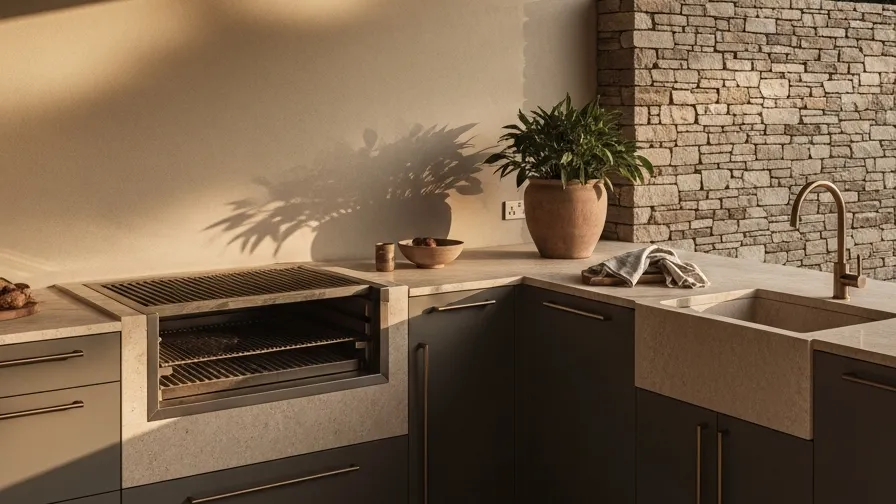
Indoor Outdoor Kitchen Stainless Steel: A Thai Villa's Seamless Transition
How 304 stainless steel eliminates the indoor-outdoor kitchen boundary with seamless Salvagnini-formed cabinet bodies and zero-formaldehyde construction.
Where the Kitchen Refuses to Choose
Indoor outdoor kitchen stainless steel Thailand installations eliminate the threshold that destroys conventional transitional spaces. The failure point of most resort kitchens is not the appliances or the layout—it is the material seam where interior climate meets tropical exterior. Wood swells, stone stains, laminates delaminate, and the kitchen becomes a maintenance liability rather than a living space.
This article examines how a single manufacturing process—Salvagnini automated bending of 304 food-grade stainless steel into seamless cabinet bodies—removes that seam entirely. The result is a kitchen surface that does not adapt to weather; it ignores it. For architects and homeowners specifying tropical indoor outdoor kitchens, this represents a shift from protective coatings to material indifference.
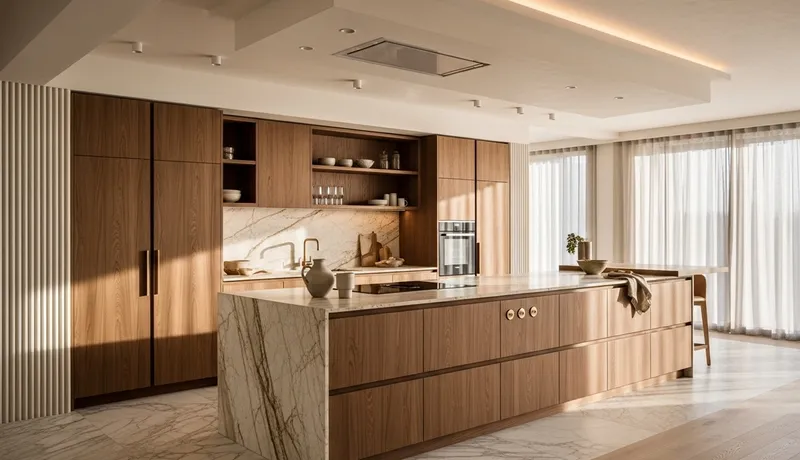
The project context is a Thai resort villa where the kitchen operates as a continuous surface from air-conditioned interior to open-air dining terrace. The specification demands three simultaneous performances: structural integrity under 90% humidity and direct rainfall, zero formaldehyde emission in semi-enclosed ventilation conditions, and aesthetic continuity across 15 meters of linear cabinetry. Conventional material systems fail at least one of these. The seamless steel approach, validated by Fadior's ADEX Platinum certification for outdoor stainless steel kitchens, satisfies all three.
Why Do Transitional Kitchens Fail at the Threshold?
The architectural problem of resort kitchen design is not weather exposure—it is differential exposure. A cabinet face receives morning sun, afternoon rain, and evening air conditioning in sequence. Traditional materials respond to each condition: expansion, contraction, moisture absorption, off-gassing. The result is predictable failure at joints, seams, and material interfaces.
From a material science perspective, 304 stainless steel (ASTM A240) achieves indifference through chromium content—18% minimum—that forms a passive oxide layer approximately 5 nanometers thick. This layer self-heals when damaged and is impermeable to water vapor, salt, and organic acids. Unlike protective coatings that degrade, the 304 surface is the material itself. Fadior's specification uses 0.6mm door panels and 1.2mm countertop substrates, with cabinet bodies formed from single sheets eliminating the 47.5% of components that would otherwise require welding.
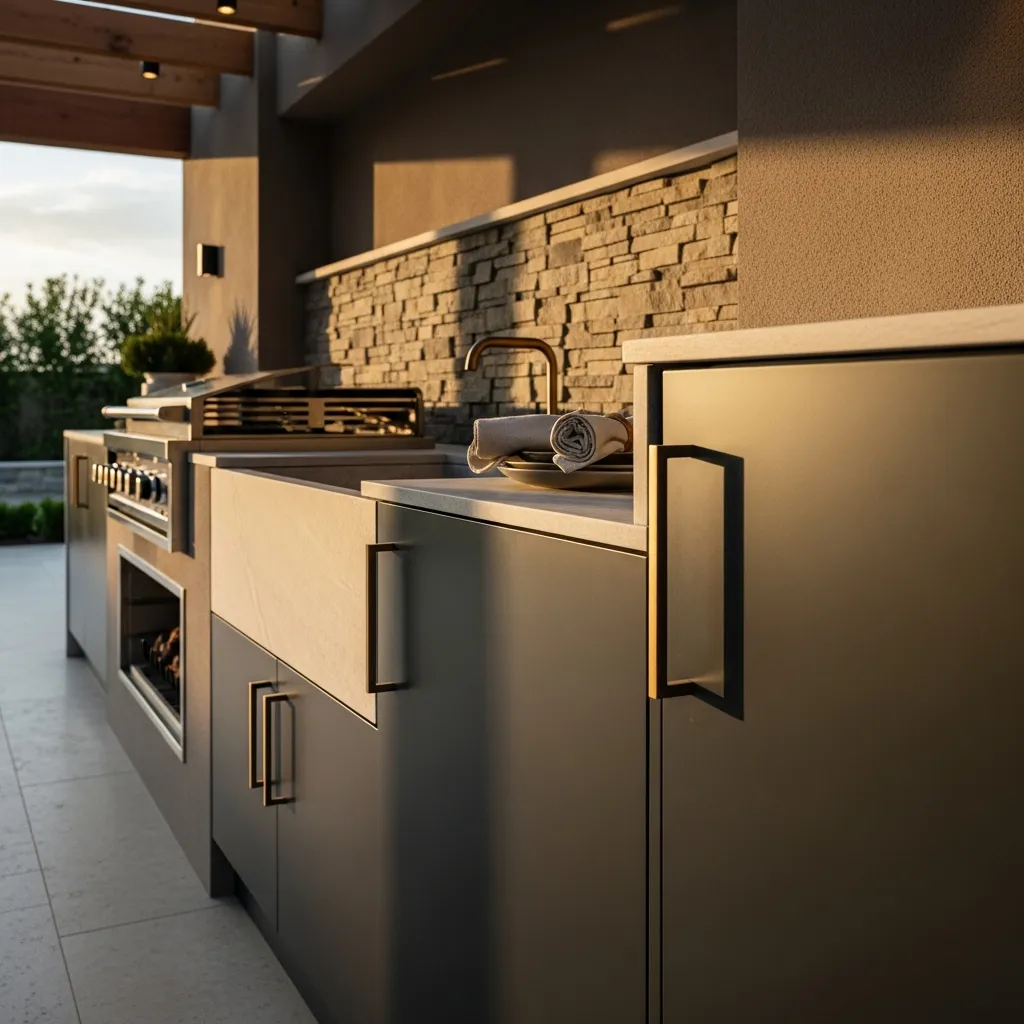
The tropical indoor outdoor kitchen thus becomes a specification of subtraction: no wood substrates to swell, no adhesives to fail, no seams to trap moisture. The kitchen surface extends from interior to exterior not as a design gesture but as a material fact. This is the architectural logic behind seamless kitchen transition—continuity achieved through manufacturing precision rather than installation compromise.
What Does ADEX Platinum Certification Actually Certify?
The ADEX Platinum award for Outdoor Stainless Steel Kitchens is not a design honor—it is a performance validation conducted under ASTM and KCMA testing protocols. The certification requires demonstrated resistance to UV degradation, salt spray corrosion, thermal cycling, and structural load under wet conditions. For resort kitchen design, this third-party verification matters because it separates marketing claims from material evidence.
Fadior's ADEX Platinum status derives from specific construction attributes: the glue-free steel frame system protected by 12 patents, which eliminates formaldehyde emission entirely rather than reducing it; the 220°C powder coat baking process that creates permanent molecular bonding rather than surface adhesion; and the microparticle crystal resin surface with gem-grade density that resists scratch, stain, and fade mechanisms simultaneously.
The 30-year cabinet body warranty operates as a design specification in itself. Typical resort renovation cycles run 10-15 years; the warranty outlasts two full cycles. This is not insurance—it is a statement about material fatigue limits. The 304 stainless steel cabinet body, formed without seams or joints, experiences no stress concentration points where corrosion initiates. The warranty period reflects engineering confidence, not marketing ambition.
Powder Coat or PVD: Which Finish Survives Tropical Light?
Specification of indoor outdoor kitchen stainless steel Thailand projects requires choosing between two finish systems with distinct degradation mechanisms. Powder coat and PVD (Physical Vapor Deposition) both achieve color on steel, but their response to tropical UV exposure, salt air, and thermal shock differs fundamentally.
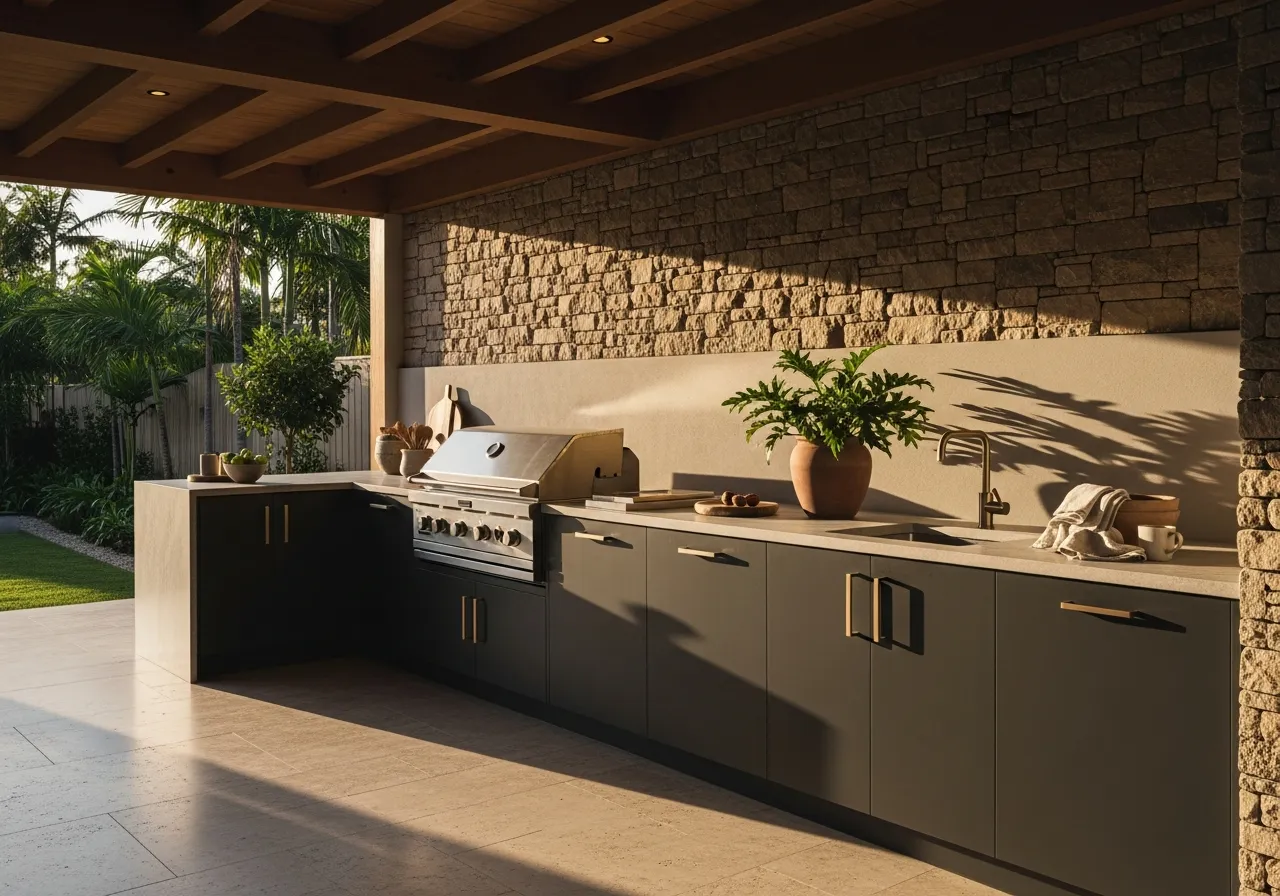
Powder coat—80+ colors baked at 220°C—creates a thermoset polymer network crosslinked to the steel substrate. The 220°C curing temperature exceeds typical surface temperatures in direct tropical sun (approximately 65-75°C for light colors, 85-95°C for dark), ensuring the coating operates well below its glass transition temperature. Fadior's process includes chain-linked crosslinking that prevents the chalking and fading common in lower-temperature cured systems. For resort applications requiring color matching to interior palettes, powder coat offers specification flexibility with demonstrated 15+ year color retention.
PVD finishes—bronze, champagne gold, rose gold—deposit metallic films at atomic scale through vacuum deposition. The film thickness measures in nanometers, not microns, meaning the color lives in the metal surface rather than on it. PVD exhibits superior scratch resistance because the coating hardness exceeds substrate hardness, and UV degradation is essentially absent since the finish contains no organic polymers. For high-touch surfaces and luxury resort kitchen design where metallic warmth is desired, PVD offers permanence that powder coat cannot match.
The specification decision reduces to use pattern: powder coat for color range and cost efficiency across large surfaces; PVD for permanence and tactile luxury at points of contact. Both systems are compatible with Fadior's seamless steel bodies, allowing mixed specifications within a single kitchen composition.
Inside the Salvagnini Bending Center: How Seamless Bodies Are Formed
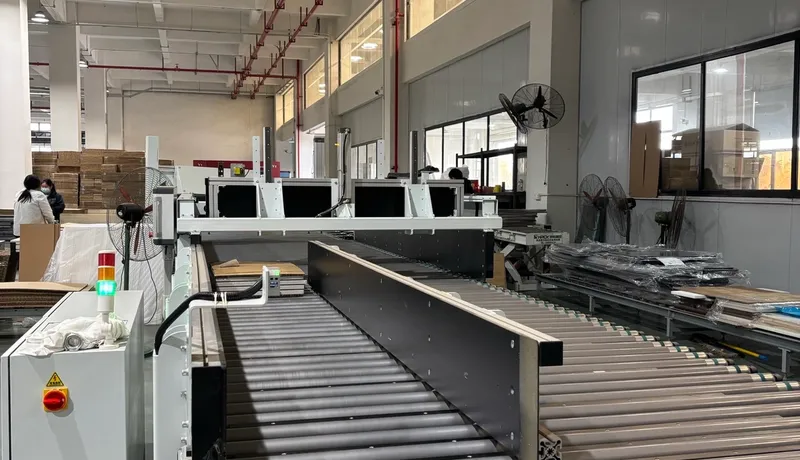
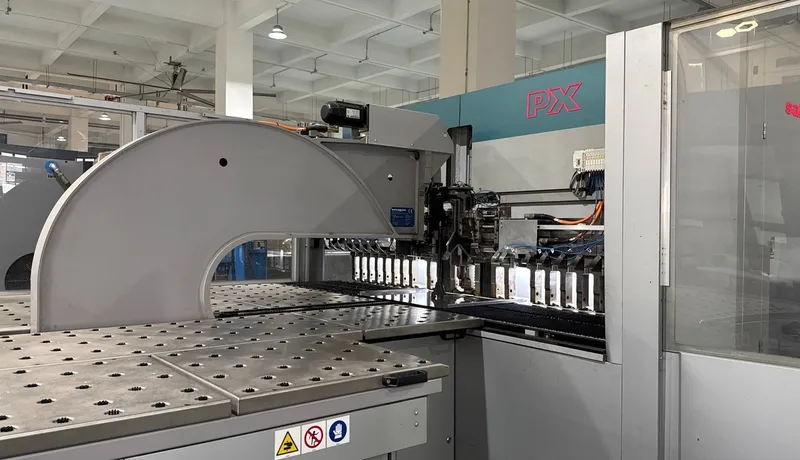
The seamless kitchen transition is manufactured, not assembled. Fadior's 80,000+ sqm Industry 4.0 facility operates Salvagnini automated bending centers—Italian premium-tier equipment that forms cabinet bodies from single 304 stainless steel sheets without cutting, welding, or jointing. This is the technical foundation of weather-proof performance.
The process sequence: flat sheet laser-cut to precision dimensions, then bent through multiple axes to achieve perfect 90° edges with radii controlled to ±0.1mm. The resulting cabinet body has no seams where moisture accumulates, no joints where thermal expansion creates stress, and no weld beads where corrosion initiates. MES barcode tracking at every workstation—236,163 scan events since May 2025—ensures dimensional consistency across production batches.
The manufacturing data supports the performance claim: 88% of tracked components (4,527 of 5,113 with data) require bending rather than welding. The 47.5% of components that do require welding are primarily hardware attachment points, not structural seams. The cabinet weight capacity—3x higher than traditional board furniture—derives from the monocoque construction: the steel skin carries load rather than framing members.
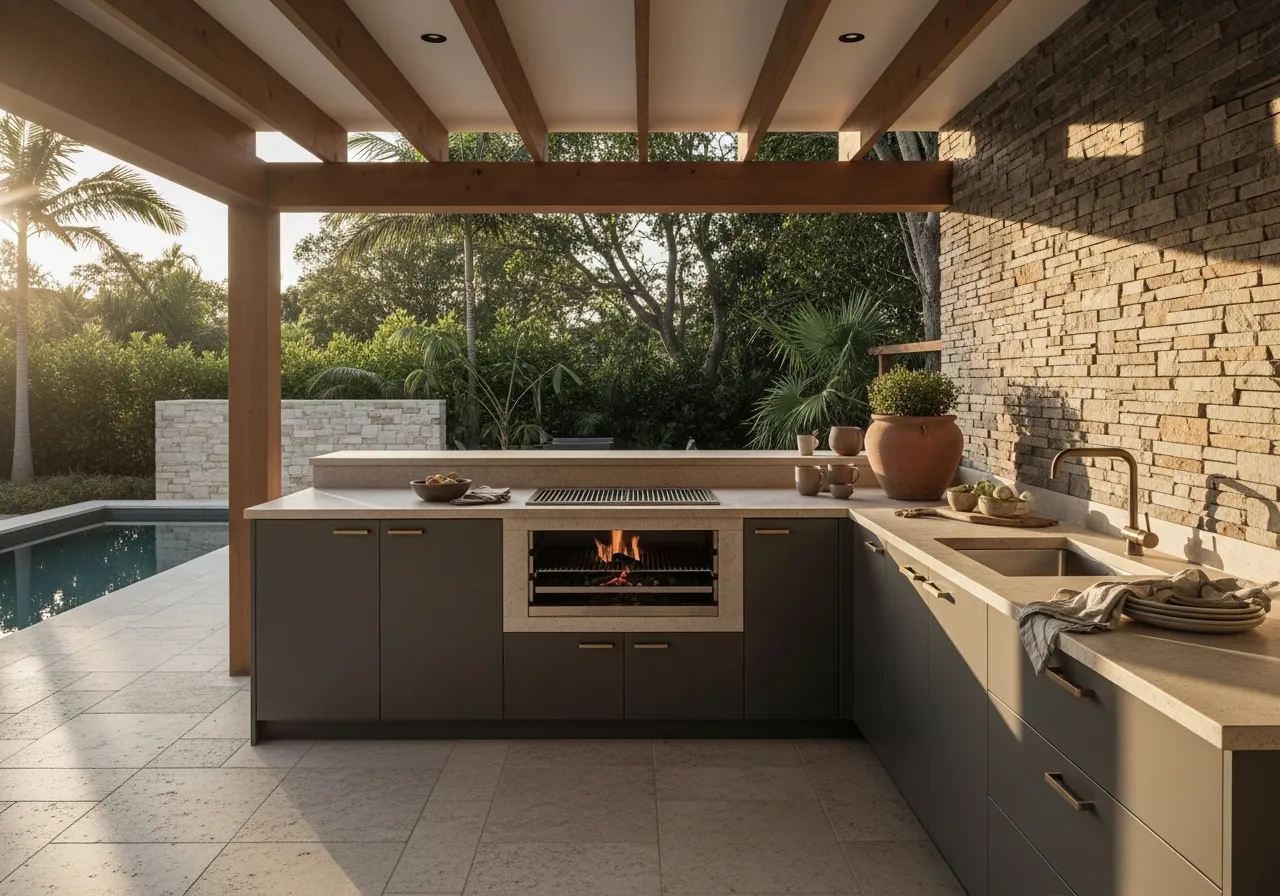
For tropical indoor outdoor kitchens, this manufacturing precision translates to dimensional stability across 15-meter runs of cabinetry. The seamless body does not rack, twist, or separate at joints because there are no joints. The specification of 304 food-grade stainless steel ensures that even food-contact surfaces maintain integrity without additional coatings or treatments.
How Do You Specify a Kitchen That Outlasts the Resort?
The final specification decision for indoor outdoor kitchen stainless steel Thailand projects is not material selection—it is system integration. The seamless steel body must connect to appropriate hardware, surface finishes, and spatial planning to achieve the promised performance.
Hardware specification: Blum hinges rated for 200,000+ open-close cycles with soft-close mechanisms standard. In salt-air environments, hinge corrosion typically precedes cabinet failure; the embedded ABS hinge mounting structure isolates stainless steel from dissimilar metal contact. Drawer systems—Fadior self-made or Blum square rail series—specify to 500mm depth for maximum storage efficiency in island configurations.
Surface specification for tropical light: bead-blasted matte or 3D wood-grain transfer finishes minimize visible fingerprinting and reduce surface temperature compared to mirror polish. Cloud-texture anti-pollution treatment provides additional fingerprint resistance for high-touch zones. For resort kitchen design requiring interior-exterior continuity, nano-coated pearl white or linen-embossed textures achieve warmth without wood's maintenance liability.
The consultation process maps these specifications to site conditions: prevailing wind patterns determine ventilation strategy for the glue-free frame's zero-formaldehyde performance; solar orientation guides finish selection for thermal and UV management; usage patterns determine hardware specification intensity. The 30-year cabinet body warranty provides specification confidence, but the design objective is a kitchen that requires no renovation across that period.
For architects and homeowners preparing to specify, the next step is material sampling: 304 stainless steel substrates with specified finishes, tested in situ for color accuracy under local light conditions. Fadior's whole-house customization capability extends the seamless steel system from kitchen to bathroom vanity, wardrobe, and architectural millwork—maintaining material continuity across the complete resort interior.
Frequently Asked Questions
Questions this guide answers
- Why does seamless construction matter more than waterproof coatings for tropical kitchens?
- Seamless construction eliminates failure points rather than protecting them. Coatings degrade at joints and seams where moisture accumulates; Fadior's Salvagnini-formed 304 steel bodies have no seams to fail. The 88% of components formed from single sheets experience no joint separation, thermal stress concentration, or corrosion initiation points that plague assembled cabinetry.
- How does 304 stainless steel compare to 316 grade for outdoor kitchen use?
- 304 stainless steel (18% chromium, 8% nickel) provides sufficient corrosion resistance for all residential and resort outdoor applications when properly finished. The 316 grade's molybdenum addition benefits marine immersion environments, but for atmospheric exposure—including salt air—304 with appropriate surface treatment performs equivalently at lower material cost. Fadior's ADEX Platinum certification validates 304 performance specifically for outdoor kitchen conditions.
- What makes Fadior's glue-free frame different from low-formaldehyde alternatives?
- Zero formaldehyde is not reduced emission—it is absence of emission source. The glue-free steel frame uses imported PET film and dry powder electrostatic spray bonded at 220°C, with 12 patents covering the manufacturing methods. When no adhesive exists in the system, there is nothing to emit, satisfying WHO and EPA guidelines for indoor air quality in semi-enclosed tropical kitchens.
- How long will powder coat or PVD finishes last in direct tropical sun?
- Powder coat finishes baked at 220°C demonstrate 15+ year color retention under UV exposure, with 80+ colors available. PVD finishes—bronze, champagne gold, rose gold—exhibit essentially unlimited UV stability since the atomic-level metallic deposition contains no organic polymers. Both are backed by Fadior's surface warranty protocols, with microparticle crystal resin providing additional scratch and fade resistance.
- What documentation should architects request for resort kitchen specifications?
- Request ADEX Platinum certification for outdoor performance validation, ASTM A240 material certification for 304 grade verification, and the 30-year cabinet body warranty terms. For projects requiring sustainability documentation, the 100% recyclability of 304 stainless steel and ISO 14001 environmental management certification support LEED and equivalent green building submissions.
Related reading
Continue exploring the journal.
More guides, whitepapers, and insights from the Fadior journal.
Material Comparison
304 Stainless Steel vs Wood Cabinets: Defining Real Durability
When evaluating 304 stainless steel vs wood cabinets, the distinction lies in structural integrity. Explore how seamless bending and zero formaldehyde standards redefine longevity.
Material Comparison
304 vs 316 Stainless Steel: The Architect's Guide to Grade Selection
When specifying residential interiors, the debate over 304 vs 316 stainless steel often overshadows construction integrity. We examine why seamless 304 architecture delivers superior longevity.
Care & Maintenance
Anti-fingerprint stainless steel: myth, reality, and maintenance
Anti-fingerprint stainless steel promises pristine surfaces, but the reality is more nuanced. Discover what actually works, what doesn't, and how Fadior engineers true fingerprint resistance.
Buyer's Guide
China vs European Stainless Steel Kitchen Cabinets: A Value Architecture Analysis
China vs European stainless steel kitchen cabinets: why tier-1 Chinese manufacturing now matches European technical specifications at one-third the landed cost, and how to audit beyond the brochure.
Material Comparison
Custom vs Semi-Custom Cabinets: What Your Budget Actually Buys
Most buyers assume semi-custom cabinets offer the optimal balance of cost and quality. The tier system obscures material realities that determine whether a kitchen appreciates or depreciates over decades.
Related products
Specific products worth reviewing next.
Editorial transparency
This article is published under a Fadior Home editorial byline produced through an editorial workflow with human review by the Fadior Home editorial team.
Actually delivered
Real homes photographed after handover, not renders.
Ready to specify?