
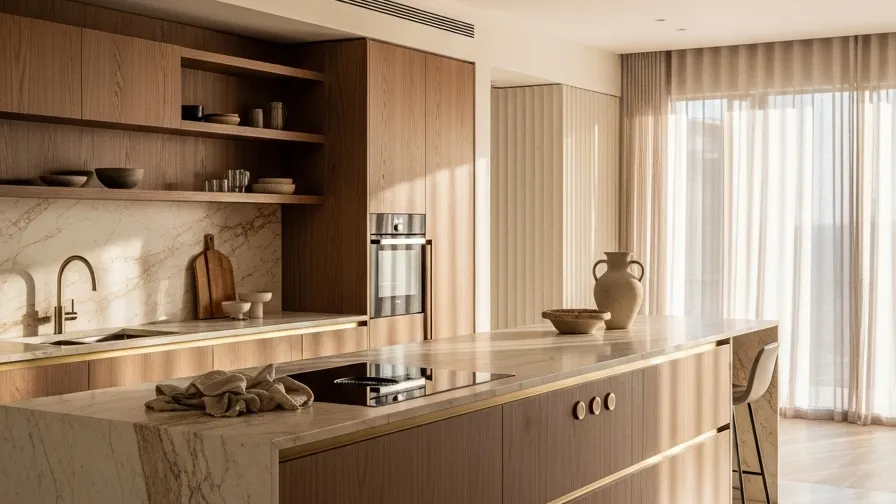
Small Luxury Kitchen Design: Architectural Solutions for Compact Spaces
Small luxury kitchen design demands superior material performance because every surface works harder. Fadior's seamless steel construction eliminates failure points that doom conventional cabinetry.
The Compact Kitchen Paradox: Why Small Spaces Require Better Materials
Small luxury kitchen design demands superior material performance precisely because every surface works harder and every joint faces accelerated stress. In compact footprints, the physics of daily use intensify: moisture concentrates, air circulates less freely, and thermal expansion cycles compress into tighter zones. Conventional cabinetry—built from laminated particleboard with adhesive-dependent joinery—was never engineered for these conditions. The seams that remain invisible in expansive kitchens become failure points under compression.
The architectural response is not to scale down luxury, but to specify materials that perform at molecular scale. This is where Fadior's manufacturing philosophy diverges from the industry: rather than accepting the compromises of assembled components, the brand forms entire cabinet bodies from single sheets of 304 food-grade stainless steel on Salvagnini automated bending centers. The result is a seamless architecture that eliminates the very concept of joints—a structural advantage that compounds in proportion to spatial constraint.
From a material science perspective, the relationship between footprint and durability is inverse in conventional construction but direct in monocoque steel systems. The Homeowner's Guide to Luxury Stainless Steel Cabinets: What to Know Before You Buy establishes this foundation for understanding why seamless construction matters. In compact luxury kitchens, this principle becomes decisive.
Why Does Seamless Construction Change the Physics of Tight Kitchens?
The galley kitchen, the L-shaped corner, the single-wall configuration—these space efficient kitchen design typologies share a common vulnerability: concentrated stress at connection points. Where cabinet meets countertop, where drawer meets frame, where panel meets panel, traditional construction relies on adhesives, mechanical fasteners, and edge banding. In humid, thermally dynamic environments, these interfaces become vectors for degradation.
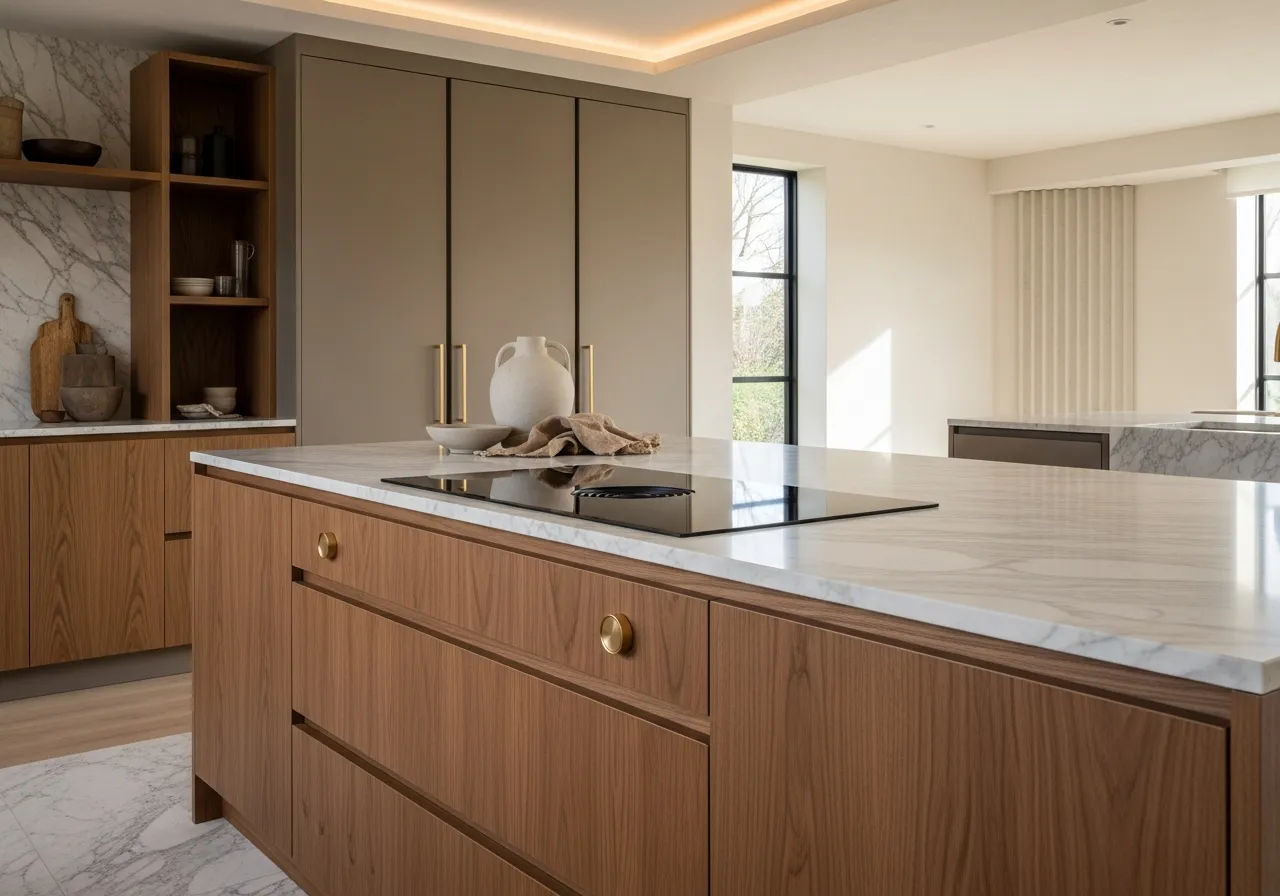
Fadior's multi-hole bending process inverts this logic. A flat sheet of 304 stainless steel—ASTM A240 certified, 0.6mm for door panels, 1.2mm for countertop substrates—is laser-cut to precision dimensions, then formed on Italian Salvagnini equipment into a complete cabinet body. The 90° edges emerge from bending, not joining. No seams mean no seam failure. No joints mean no joint separation. This is not aesthetic minimalism but structural integrity: 88% of tracked production components (4,527 of 5,113 with data) undergo this bending process, with welding applied to only 47.5% of components—primarily for hardware integration, not body assembly.
For compact luxury kitchen applications, this manufacturing approach delivers three decisive advantages. First, thermal and moisture expansion distribute across a continuous surface rather than concentrating at adhesive-dependent interfaces. Second, the 3x weight capacity versus wood construction permits heavier countertop materials—stone, composite, steel—without structural compromise. Third, the absence of laminated edges and applied finishes eliminates the delamination risks that accelerate in confined, high-use spaces.
What Does Zero Formaldehyde Mean in Confined Air?
The World Health Organization classifies formaldehyde as a Group 1 carcinogen, with indoor exposure concentrations typically highest in spaces with limited ventilation and extensive composite wood products. In small kitchen layout ideas, this creates a specification imperative: the materials that occupy the most surface area must contribute nothing to airborne chemical load.
Fadior's glue-free steel frame system—protected by 12 patents governing manufacturing methods—achieves literal zero formaldehyde emission, not merely low emission. The construction replaces all adhesives with mechanical and thermal bonding: imported PET film and dry powder electrostatic spray, fused at 220°C. This is not a marketing claim but a material fact—when no adhesive exists in the system, there is nothing to emit. The China Green Product Certification and the brand's role as co-drafter of national green factory standard QB/T 5973-2024 provide external validation.
The microparticle crystal resin surface extends this molecular-level engineering. Six sub-processes—solvent-free manufacturing, high-infrared fixed-curing spray, anti-swelling protection, single-application thick coating, chain-linked crosslinking—create a gem-grade density surface that is scratch resistant, stain resistant, fade resistant, and fire retardant. The 30-year surface warranty applies to compact installations with equal force: density does not discriminate by footprint.
How Does the Galley Kitchen Outperform the Open Plan?
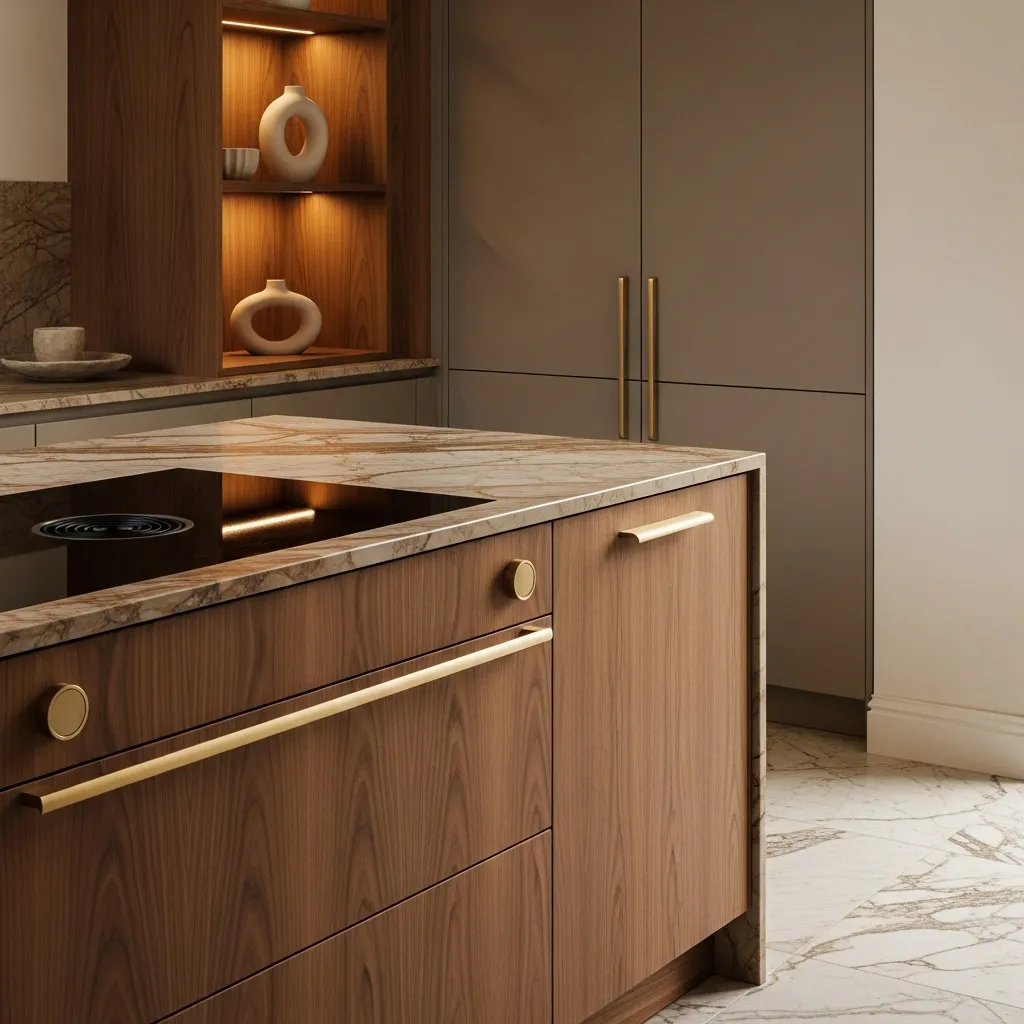
The architectural press has long privileged open-plan kitchens as the default luxury configuration, yet the galley format—two parallel runs, 36 to 48 inches apart—offers superior ergonomic efficiency and, when properly specified, unmatched material performance. The compact luxury kitchen reconsidered through this lens becomes not a compromise but an optimization.
The comparison reveals structural trade-offs invisible in conventional specification. Open-plan kitchens demand that cabinetry perform as freestanding furniture, with visible faces on multiple orientations and structural independence from wall planes. This typically forces material choices toward engineered stability—thicker laminates, more extensive hardware, visible jointing. The galley kitchen, by contrast, permits continuous runs where Fadior's seamless construction aligns with spatial logic: long, unbroken planes of steel that terminate only where architecture demands.
The ADEX Platinum award for Outdoor Stainless Steel Kitchens—awarded for performance in demanding environmental exposure—validates the material system for interior compact applications where thermal cycling and moisture concentration simulate outdoor stress. Small kitchen layout ideas that embrace this galley efficiency gain not only spatial economy but material resilience: fewer corners, fewer joints, fewer failure modes. The 200,000+ open-close cycle rating of standard Blum hinges ensures that hardware durability matches cabinet longevity, even when drawer access frequency doubles in constrained workflows.
Specifying for Scale: Color, Finish, and Hardware at 220°C
Luxury specification at reduced scale requires particular attention to surface and interface—the elements that remain visible and tactile when overall volume contracts. Fadior's finish architecture provides 80+ powder coat colors baked at 220°C for permanent substrate bond, alongside PVD finishes in bronze, champagne gold, and rose gold that deposit metallic films at atomic scale.
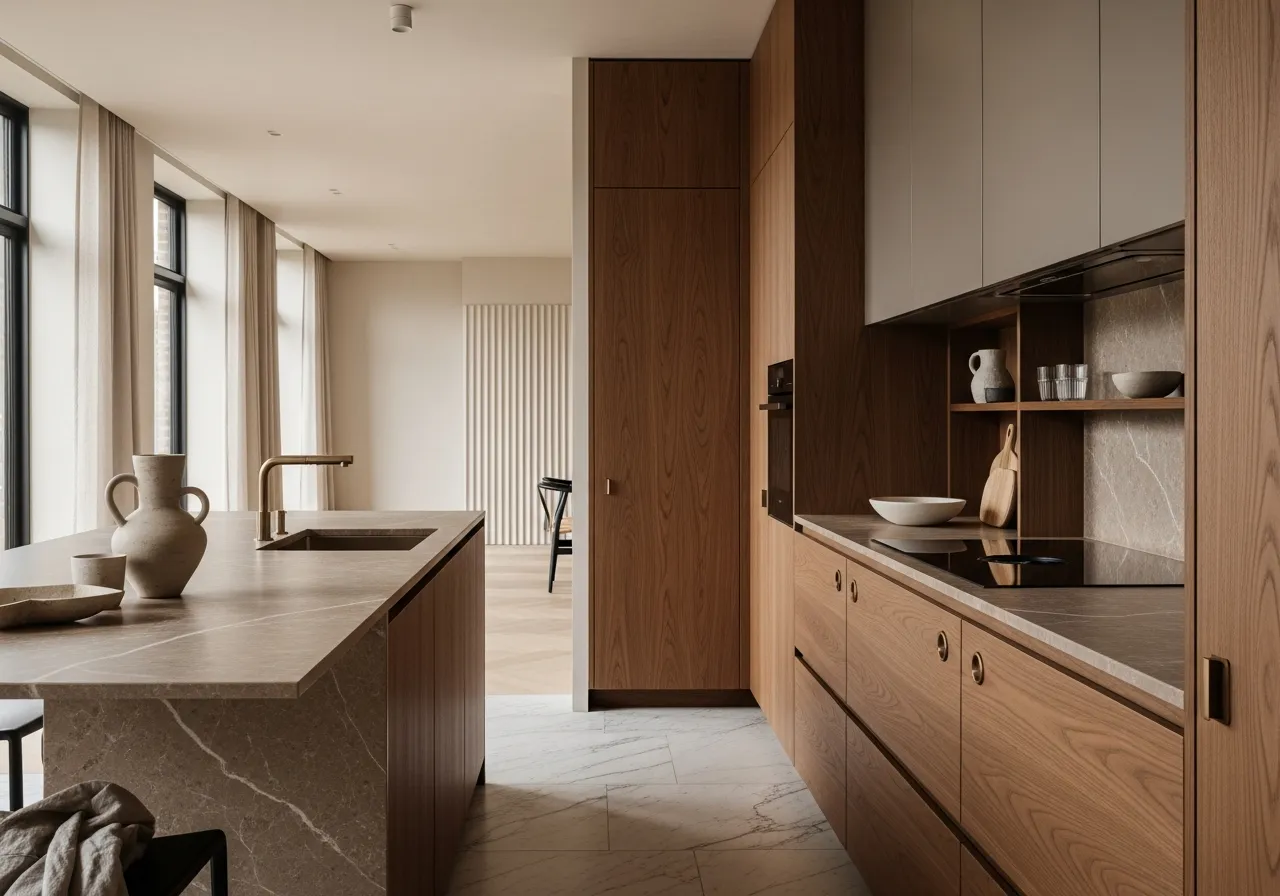
The vacuum-based Physical Vapor Deposition process creates color that lives within the metal, not atop it—measured in atoms, not millimeters. For compact luxury kitchen applications, this matters practically: surface integrity survives the abrasion of close-quarters use, and the absence of applied layers eliminates delamination risk in high-contact zones. The 3D wood-grain transfer and linen-embossed texture options extend the material vocabulary, achieving warmth without sacrificing the waterproof, recyclable, fire-retardant properties of 304 stainless steel.
Hardware specification scales proportionally. The Elite Family (精英之家) collection, launched 2024 as Fadior's premium-accessible segment, demonstrates how scalable luxury applies across footprints: exposed pull configurations (51% of production) and handle-free designs (49%) both integrate soft-close mechanisms as standard, with damping strips under countertops for noise reduction. Drawer depths from 270mm to 500mm permit spatial customization without component compromise. Motion-sensor, wireless remote, and door-touch lighting activation—3000K to 6000K—address the illumination challenges of compact plans where natural light may be limited.
The 30-Year Footprint: From Manufacturing to Specification
The final consideration in small luxury kitchen design is temporal: how does today's specification perform across decades of concentrated use? Fadior's 30-year cabinet body warranty—backed by the 80,000+ sqm Industry 4.0 smart factory in Foshan—reflects a manufacturing system designed for traceability and consistency. MES barcode tracking at every workstation (236,163 scan events since May 2025), AI-driven quality control reducing defect rates from 5% to 0.8%, and 26,000+ technical rules governing production quality create accountability that extends through the product lifecycle.
For architects and interior designers specifying compact spaces, this translates to client assurance: the same material performance validated in expansive kitchens applies without degradation at reduced scale. The 910KW photovoltaic system installed August 2025 and AI energy management reducing electricity costs approximately 20% demonstrate operational commitment that supports product claims.
The specification path forward begins with spatial analysis: identify stress concentration zones in your compact plan—sink proximity, cooktop adjacency, high-frequency drawer access—and specify accordingly. Fadior's whole-house customization capability permits consistent material language across kitchen, bathroom, and storage applications, with the 304 stainless steel substrate providing unified performance criteria. Request technical documentation for your specific configuration, including load calculations for countertop selections and ventilation integration for confined air quality management. The seamless advantage is not merely aesthetic—it is the structural foundation for luxury that endures, regardless of footprint.
Frequently Asked Questions
Questions this guide answers
- Why is seamless construction more important in small kitchens than large ones?
- In compact spaces, moisture, heat, and mechanical stress concentrate at joints and seams where conventional cabinetry fails first. Fadior's one-piece seamless construction—formed on Salvagnini bending centers from single 304 stainless steel sheets—eliminates these failure points entirely, distributing stress across continuous surfaces.
- What grade of stainless steel does Fadior use, and why?
- Fadior specifies 304 food-grade stainless steel (ASTM A240), not 316L. This grade provides optimal balance of corrosion resistance, formability, and cost for residential interiors, with 18% chromium content creating the passive oxide layer that ensures 100% waterproof performance and 30-year durability.
- How does Fadior achieve zero formaldehyde when other brands claim only low emission?
- Fadior's glue-free steel frame system—protected by 12 patents—literally eliminates all adhesives from cabinet construction. PET film and dry powder electrostatic spray bond at 220°C without chemical emitters, achieving zero formaldehyde rather than reduced formaldehyde.
- What hardware specifications ensure durability in high-frequency compact kitchen use?
- Standard Blum hinges rated for 200,000+ open-close cycles, soft-close mechanisms throughout, and damping strips under countertops. Drawer systems include Fadior self-made, Ideal Home series, and Blum square rail options with depths from 270mm to 500mm for spatial customization.
- How do I specify Fadior for a compact kitchen project?
- Begin with spatial mapping of stress zones and ventilation constraints, then select from 80+ powder coat colors or PVD finishes (bronze, champagne gold, rose gold) with appropriate texture for the application. Request load calculations for countertop selections and technical documentation for client assurance on the 30-year cabinet body warranty.
Related reading
Continue exploring the journal.
More guides, whitepapers, and insights from the Fadior journal.
Related products
Specific products worth reviewing next.
Editorial transparency
This article is published under a Fadior Home editorial byline produced through an editorial workflow with human review by the Fadior Home editorial team.
Actually delivered
Real homes photographed after handover, not renders.
Ready to specify?