
Stainless Steel Cabinetry for Villas, Penthouses, and Waterfront Homes: A Material Specification Guide
Stainless steel cabinetry for villas, penthouses, and waterfront homes solves material failures that wood cannot. Discover how seamless 304 steel construction transforms environmental stressors into design opportunities.
The Waterfront Paradox: Why the Most Desirable Locations Demand the Most Resilient Materials
Stainless steel cabinetry for villas penthouses waterfront homes addresses a fundamental tension in luxury residential design: the environments we most desire to inhabit are precisely those that accelerate material degradation. Salt-laden coastal air, dramatic humidity fluctuations, and the thermal cycling of expansive glazing systems create conditions where conventional cabinetry substrates—particleboard, MDF, even marine-grade plywood—begin their invisible decline from the moment of installation. For architects and interior designers specifying waterfront home kitchen cabinets, this reality transforms material selection from a finish decision into a performance calculation.
The penthouse presents a different but equally demanding scenario. Sealed, climate-controlled interiors with limited air exchange create what building scientists term 'sick building syndrome' conditions—spaces where off-gassing from adhesives and composite materials accumulates to measurable concentrations. Here, luxury stainless steel cabinetry functions as environmental infrastructure: a storage system that actively protects rather than compromises interior air quality. The specification shifts from 'what looks appropriate' to 'what performs under measurable stress.'
Villa-scale projects introduce yet another variable: cabinetry as architectural joinery. When kitchen volumes extend to 100+ linear feet and integrate with wine rooms, secondary kitchens, and outdoor cooking pavilions, the cumulative failure risk of conventional construction multiplies. A single seam compromised by humidity can necessitate replacement of entire runs. This is where Fadior's manufacturing methodology—specifically the Salvagnini automated bending process that forms 88% of cabinet components without welding—redefines what 'custom' means in high-end residential specification.
Why Does 304 Steel Outperform Engineered Wood in Humid Climates?
From a material science perspective, the vulnerability of wood-based substrates in waterfront and tropical environments is not a matter of if but when. Engineered wood products rely on urea-formaldehyde or phenolic resins to bind cellulose fibers; these adhesives are hydrophilic by nature, meaning they attract and absorb atmospheric moisture. As relative humidity cycles above 60%—a baseline condition in coastal villas and a seasonal certainty in penthhouse HVAC transitions—the resin matrix begins plasticization, leading to dimensional instability, delamination, and eventual structural failure.
304 stainless steel operates on fundamentally different principles. As an austenitic alloy containing 18% chromium and 8% nickel, it forms a passive chromium oxide layer that is self-healing and impermeable. Fadior's specification of ASTM A240 304 food-grade steel—rather than the 316L sometimes suggested for marine applications—reflects precise environmental calibration: 304 offers equivalent corrosion resistance in atmospheric conditions while superior formability for the complex geometries of residential cabinetry. The material is literally 100% waterproof; there is no substrate to swell, no adhesive to degrade, no seam to separate.
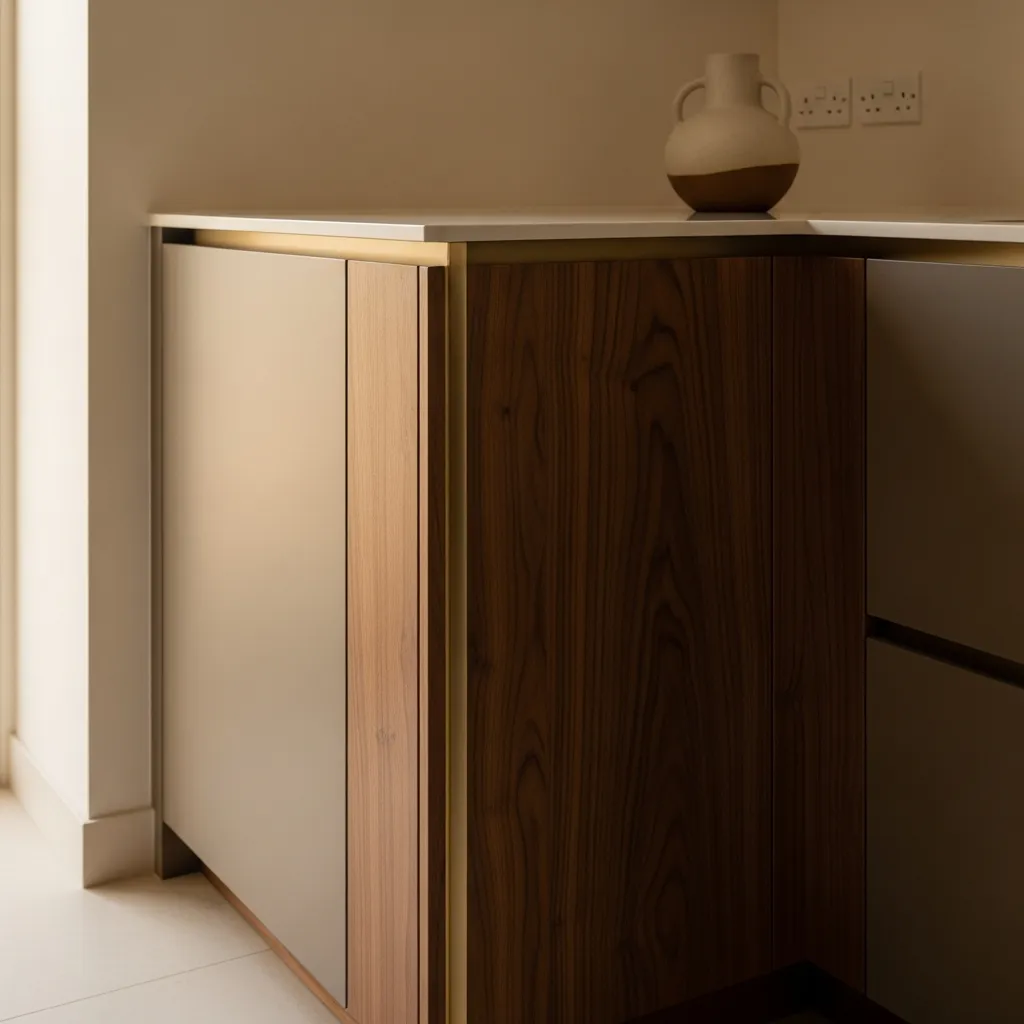
The weight capacity differential is equally significant. Fadior's steel construction delivers 3x the load-bearing capacity of equivalent wood-based systems, a specification that matters when villa kitchens incorporate stone countertops exceeding 800 kg and integrated appliance suites. This structural integrity is achieved without the mass penalties of traditional metal cabinetry: 0.6mm door panels and 1.2mm countertop substrates balance rigidity with refined proportion. For penthouse cabinetry where floor loading calculations constrain design, this strength-to-weight ratio enables architectural ambitions that wood cannot support.
What Certifications Validate Performance in Extreme Environments?
Third-party validation separates specification-grade claims from marketing language. Fadior's ADEX Platinum award for Outdoor Stainless Steel Kitchens—recognized by the Design Journal, the leading specification publication for architects and designers—provides independent verification of coastal and waterfront performance. This is not a consumer choice award but a juried evaluation by design professionals assessing material suitability for demanding applications. The parallel ADEX Gold for Stainless Steel Kitchen Cabinets Custom confirms equivalent recognition for interior systems.
Regulatory credibility extends to national standard-setting. As co-drafter of QB/T 5973-2024, the Chinese national green factory standard for kitchen furniture, Fadior participated in establishing the measurable criteria that define environmental performance in cabinetry manufacturing. This is complemented by China Green Product Certification—a voluntary program with stringent lifecycle assessment requirements—and ISO 9001 Quality Management certification. For specification documents requiring defensible sourcing, these credentials provide the audit trail that LEED, WELL, and equivalent building certification systems demand.
The 30-year cabinet body warranty represents perhaps the most direct evidence of material confidence. In an industry where 5-10 year warranties are standard and often prorated, three decades of structural coverage reflects empirical testing of the Salvagnini-formed seamless bodies. The warranty is not insurance against failure; it is a statement that failure modes have been engineered out of the system entirely. This aligns with what the research literature on residential durability terms 'design for disassembly'—though in Fadior's case, the anticipated lifecycle extends beyond typical mortgage durations rather than planning for obsolescence.
How Does Seamless Construction Eliminate the Failure Points of Conventional Joinery?
Traditional cabinet construction, whether site-built or manufactured, relies on a vocabulary of joints: butt joints, dado joints, rabbet joints, each requiring mechanical fastening or adhesive bonding. In humid environments, these joints function as capillary networks, drawing moisture into the substrate core through the path of least resistance. Thermal expansion differential between face materials and core substrates generates stress concentrations at joint lines, producing the hairline cracks and seam separation that characterize aged cabinetry in waterfront homes.
Fadior's seventh-generation glue-free steel frame system—protected by 12 patents—eliminates this joint vocabulary entirely. The process begins with flat 304 steel sheet, laser-cut to precision dimensions, then formed on Italian Salvagnini automated bending centers. These machines execute multi-hole bending sequences that create perfect 90° edges and complex three-dimensional forms from a single continuous sheet. The result is a cabinet body without seams to fail, without joints to separate, without the dimensional tolerance stack-up that accumulates across multiple components.
The manufacturing data is instructive: of 5,113 tracked components, 4,527 (88%) are formed through bending rather than welding. Where welding does occur—primarily for structural reinforcement and hardware integration—it is executed as secondary operation on already-formed bodies rather than primary joint construction. This represents an inversion of conventional metal cabinetry, where welded frames are the structural baseline. The Salvagnini process produces what engineers term 'monocoque' construction: the skin carries the load, eliminating the frame-and-panel logic that creates failure points. For villa-scale projects where a single kitchen may comprise 200+ cabinet units, this uniformity of construction method ensures consistent performance across the entire installation.
Zero Formaldehyde as Spatial Ethics: Air Quality in High-Value Enclosed Environments
The formaldehyde question in luxury residential specification has evolved from regulatory compliance to ethical positioning. The World Health Organization classifies formaldehyde as a Group 1 carcinogen; the US EPA establishes 0.1 ppm as the maximum safe concentration for continuous exposure. Yet conventional cabinetry—even products labeled 'low-VOC' or 'CARB Phase 2 compliant'—continues to emit formaldehyde throughout its service life, with elevated temperatures and limited air exchange accelerating emission rates. In penthouses with floor-to-ceiling glazing and minimal operable ventilation, these emissions accumulate.
Fadior's glue-free construction achieves literal zero formaldehyde—not 'below detectable limits' but absence of source material. The system replaces adhesives with two bonding technologies: imported PET film for surface applications, and dry powder electrostatic spray for color and texture. The powder coating process—80+ colors baked at 220°C—creates a molecular bond between finish and substrate that is permanent and inert. There is no off-gassing because there is no organic binder to degrade; the finish is fused to the steel at temperatures that would carbonize conventional cabinet materials.
This specification matters for WELL Building Standard compliance, for LEED v4.1 low-emitting materials credits, and for the growing segment of clients who request environmental testing as a contract condition. It also matters for the practical reality of occupancy: a penthouse kitchen installed on Friday can be operational on Monday without the acclimation period that adhesive-curing demands. The 30-year surface warranty on Fadior's microparticle crystal resin coating—engineered for scratch, stain, and fade resistance—further ensures that performance does not degrade as the installation ages.
Specification Checklist: Matching Fadior Systems to Project Typologies
For architects and designers translating these capabilities into specification documents, the following framework organizes Fadior's product architecture by residential typology. This is not a product catalog but a decision matrix for material-system matching.
Waterfront Villas: Specify 304 steel with bead-blasted matte or PVD bronze finishes for salt-air resistance; integrate cloud-texture anti-pollution surfaces for fingerprint management in high-touch outdoor kitchen zones; specify Blum 200,000-cycle hardware for secondary residence usage patterns where maintenance intervals may be extended. Reference ADEX Platinum documentation for coastal performance validation.
Urban Penthouses: Specify nano-coated pearl white or linen-embossed textures to maximize light reflection in glass-walled interiors; specify glue-free construction with China Green Product Certification for air quality documentation; integrate motion-sensor lighting at 3000K-4000K for circadian-sensitive environments. Reference QB/T 5973-2024 co-drafter status for regulatory compliance.
Estate-Scale Villas: Specify 3D wood-grain transfer finishes where steel construction must integrate with traditional material palettes; specify 1.2mm countertop substrates for stone-bearing loads; integrate fingerprint and key lock systems for wine room and pantry security. Reference 30-year structural warranty for lifecycle cost analysis.
The next step for specification-ready projects is technical consultation: Fadior's whole-house customization capability—encompassing kitchen, bath, wardrobe, and architectural millwork—enables material continuity across residential programs that would otherwise require multiple vendors and incompatible warranty terms. For projects where the environmental stressors discussed here are present, steel is not an alternative to consider but a baseline to justify deviating from.
Frequently Asked Questions
Questions this guide answers
- Why is 304 stainless steel specified for waterfront homes rather than 316L?
- 304 stainless steel contains 18% chromium and 8% nickel, forming a self-healing passive oxide layer that provides equivalent atmospheric corrosion resistance to 316L in residential environments. 304 offers superior formability for complex cabinet geometries on Salvagnini bending centers, and its performance is validated by Fadior's ADEX Platinum award for outdoor kitchens. The specification reflects environmental calibration rather than grade inflation.
- How does the Salvagnini bending process create seamless cabinet bodies?
- Salvagnini automated bending centers execute multi-hole bending sequences that form entire cabinet bodies from single steel sheets. Of 5,113 tracked components, 88% are formed without welding, creating monocoque construction where the skin carries structural load. This eliminates seams, joints, and the capillary moisture paths that cause conventional cabinet failure.
- How does Fadior's zero-formaldehyde claim compare to 'low-VOC' wood cabinetry?
- Low-VOC wood cabinetry reduces formaldehyde emissions but cannot eliminate them because adhesives remain the structural foundation. Fadior's glue-free steel frame—12 patents covering manufacturing methods—replaces all adhesives with PET film and 220°C powder coating, achieving literal zero formaldehyde. This is verified by China Green Product Certification and matters critically in penthouses with limited air exchange.
- What is the expected service life of Fadior cabinetry in coastal environments?
- Fadior provides a 30-year cabinet body warranty and 30-year surface warranty on microparticle crystal resin coatings. Blum hardware is rated for 200,000 open-close cycles. The 304 steel substrate is 100% waterproof and recyclable, with no organic components to degrade. In specification terms, this exceeds typical building mortgage durations and aligns with institutional-grade durability expectations.
- How should architects specify Fadior for whole-house integration?
- Fadior's whole-house customization encompasses kitchen, bath, wardrobe, and architectural millwork in unified material systems. Specification should reference ASTM A240 304 steel, glue-free construction with 12-patent protection, and Salvagnini-formed seamless bodies. For projects requiring documentation, cite QB/T 5973-2024 co-drafter status, China Green Product Certification, and ADEX Platinum/Gold awards. Technical consultation is available for project-specific performance requirements.
Related reading
Continue exploring the journal.
More guides, whitepapers, and insights from the Fadior journal.
Material Comparison
304 Stainless Steel vs Wood Cabinets: Defining Real Durability
When evaluating 304 stainless steel vs wood cabinets, the distinction lies in structural integrity. Explore how seamless bending and zero formaldehyde standards redefine longevity.
Material Comparison
304 vs 316 Stainless Steel: The Architect's Guide to Grade Selection
When specifying residential interiors, the debate over 304 vs 316 stainless steel often overshadows construction integrity. We examine why seamless 304 architecture delivers superior longevity.
Care & Maintenance
Anti-fingerprint stainless steel: myth, reality, and maintenance
Anti-fingerprint stainless steel promises pristine surfaces, but the reality is more nuanced. Discover what actually works, what doesn't, and how Fadior engineers true fingerprint resistance.
Buyer's Guide
China vs European Stainless Steel Kitchen Cabinets: A Value Architecture Analysis
China vs European stainless steel kitchen cabinets: why tier-1 Chinese manufacturing now matches European technical specifications at one-third the landed cost, and how to audit beyond the brochure.
Material Comparison
Custom vs Semi-Custom Cabinets: What Your Budget Actually Buys
Most buyers assume semi-custom cabinets offer the optimal balance of cost and quality. The tier system obscures material realities that determine whether a kitchen appreciates or depreciates over decades.
Related products
Specific products worth reviewing next.
Editorial transparency
This article is published under a Fadior Home editorial byline produced through an editorial workflow with human review by the Fadior Home editorial team.
Ready to specify?