
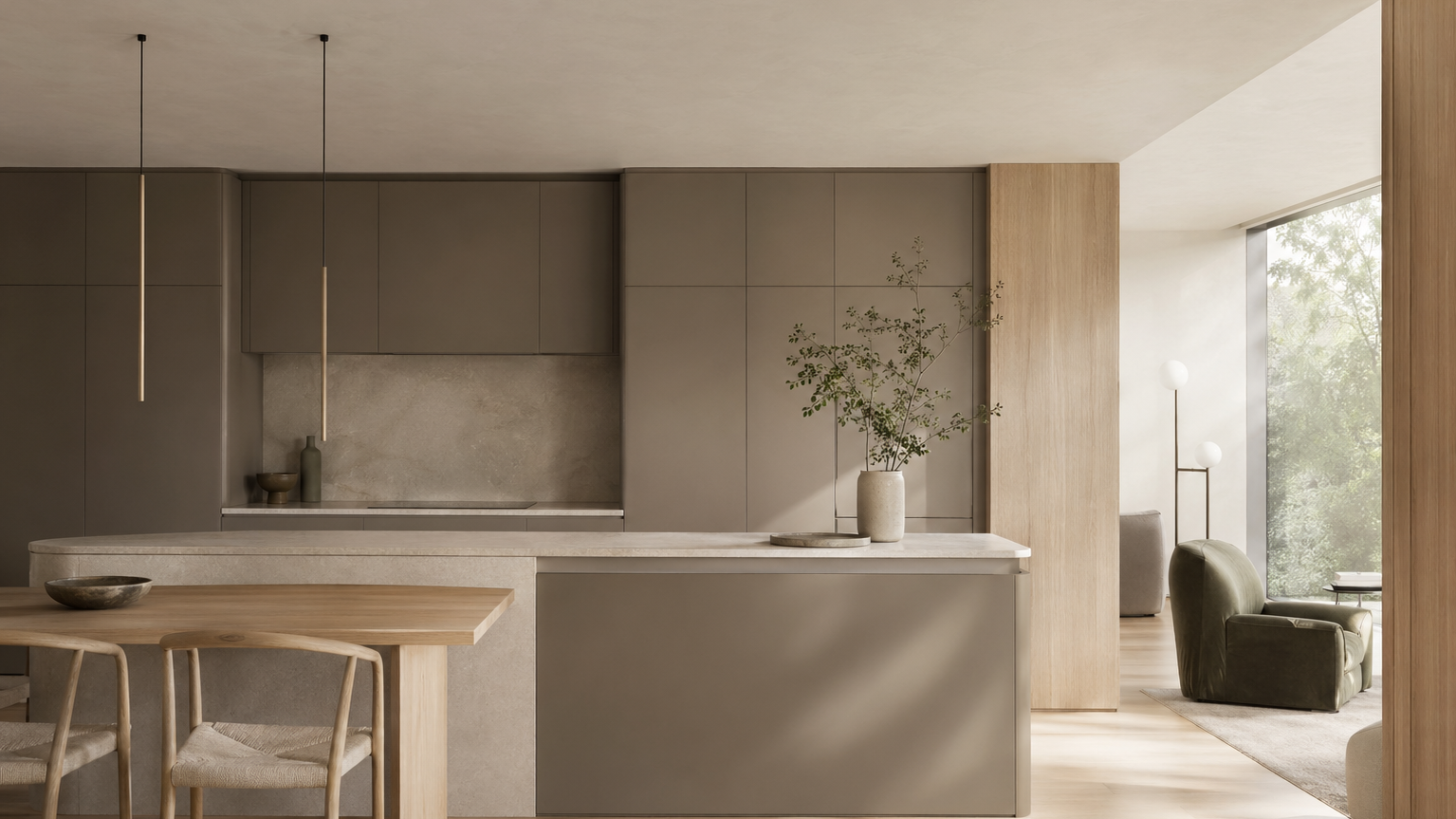
Minimalist Luxury Kitchen Design: What Quiet Materiality Really Requires
Define quiet luxury kitchen design through material choice, color, hardware, lighting, and durable 304 stainless steel cabinet structure.
Direct answer
The Direct Answer
Minimalist luxury kitchen design works when the room feels calm because its materials agree with one another, not because everything was stripped away. The best current examples use warm stone, controlled cabinet tones, restrained fittings, and cabinet-body engineering that keeps broad surfaces stable over time. Quiet materiality is the discipline of making those choices feel effortless.
What is quiet materiality in minimalist luxury kitchen design?
Minimalist luxury kitchen design is often misunderstood as a styling exercise. The stronger reading is that it is a material discipline. Quiet materiality means the room feels calm not because everything was stripped away, but because every remaining surface behaves clearly. Tone, reflectance, texture, and touch all agree with one another. The room does not beg for attention, yet nothing feels accidental.
That is why today's editor brief matters. It points to Naoto Fukasawa not as a celebrity reference but as a useful filter. On Maruni's official pages, Fukasawa is framed around design that translates unconscious human behavior into usable calm, while the company says it has worked with him as art director since 2010. Fantini describes his AF/21 series as an exercise in maximum clarity where the aesthetic quality of materials comes forward as form becomes simpler. Read together, those sources explain the core lesson for kitchens: minimalism works when material quality becomes more legible as form becomes quieter.
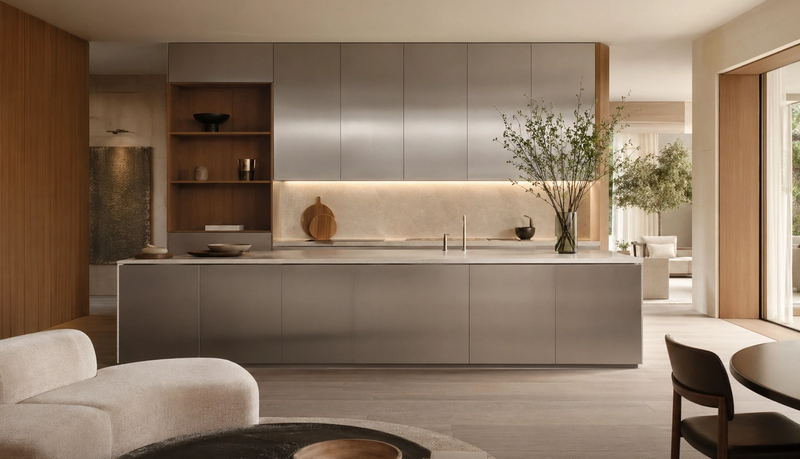
For Fadior, that lesson is commercially important because the brand does not win by selling emptiness. It wins when a buyer understands that broad powder-coated cabinet planes, warm oak notes, pale stone, controlled lighting, and a durable 304 cabinet body can all cooperate. The best minimalist rooms feel warm because the specification is disciplined, not because the designer added decoration later.
- Quiet materiality
- Quiet materiality is a design approach in which surfaces, joins, tones, and textures work so coherently that the room feels calm before any object tries to become a statement.
| Design question | Showroom-only answer | Quiet materiality answer | Fadior specification implication |
|---|---|---|---|
| What makes a minimalist kitchen feel calm? | Hide everything visually and keep the palette pale. | Reduce visual noise while making every surface, joint, and transition feel intentional to the hand and eye. | Favor flush planes, broad cabinet faces, hidden service zones, and finish pairings that stay stable over time. |
| How should warmth enter the room? | Add wood color or decorative accessories late in the process. | Build warmth through tone, reflectance, texture, and proportion so the room never depends on clutter for comfort. | Pair powder-coated cabinet planes with oak notes, soft stone, plaster, and muted lighting instead of ornamental add-ons. |
| Why does construction matter to aesthetics? | It only matters if something breaks. | Construction determines whether minimal surfaces stay quiet or start telegraphing seams, swelling, and maintenance stress. | One-piece cabinet-body logic and glue-free framing protect the visual calm that minimalism depends on. |
| How should fixtures behave? | Use statement pieces to create contrast. | Use fixtures that read as clear, precise objects whose material quality is obvious without shouting. | Choose crisp profiles, restrained detailing, and surfaces that coordinate with the room rather than stealing it. |
Why is Naoto Fukasawa a useful reference instead of a style idol?
The useful part of Fukasawa's work is not a checklist of shapes. It is the relationship between restraint and material honesty. When Fantini explains AF/21, it talks about simplification, clarity, and the way form can be reduced until the quality of the material becomes more visible. That is exactly the problem many luxury kitchens still fail to solve. They want the calm visual language of minimalism, but they specify too many competing finishes, too many contrast moments, or too much decorative correction after the main architecture is already noisy.
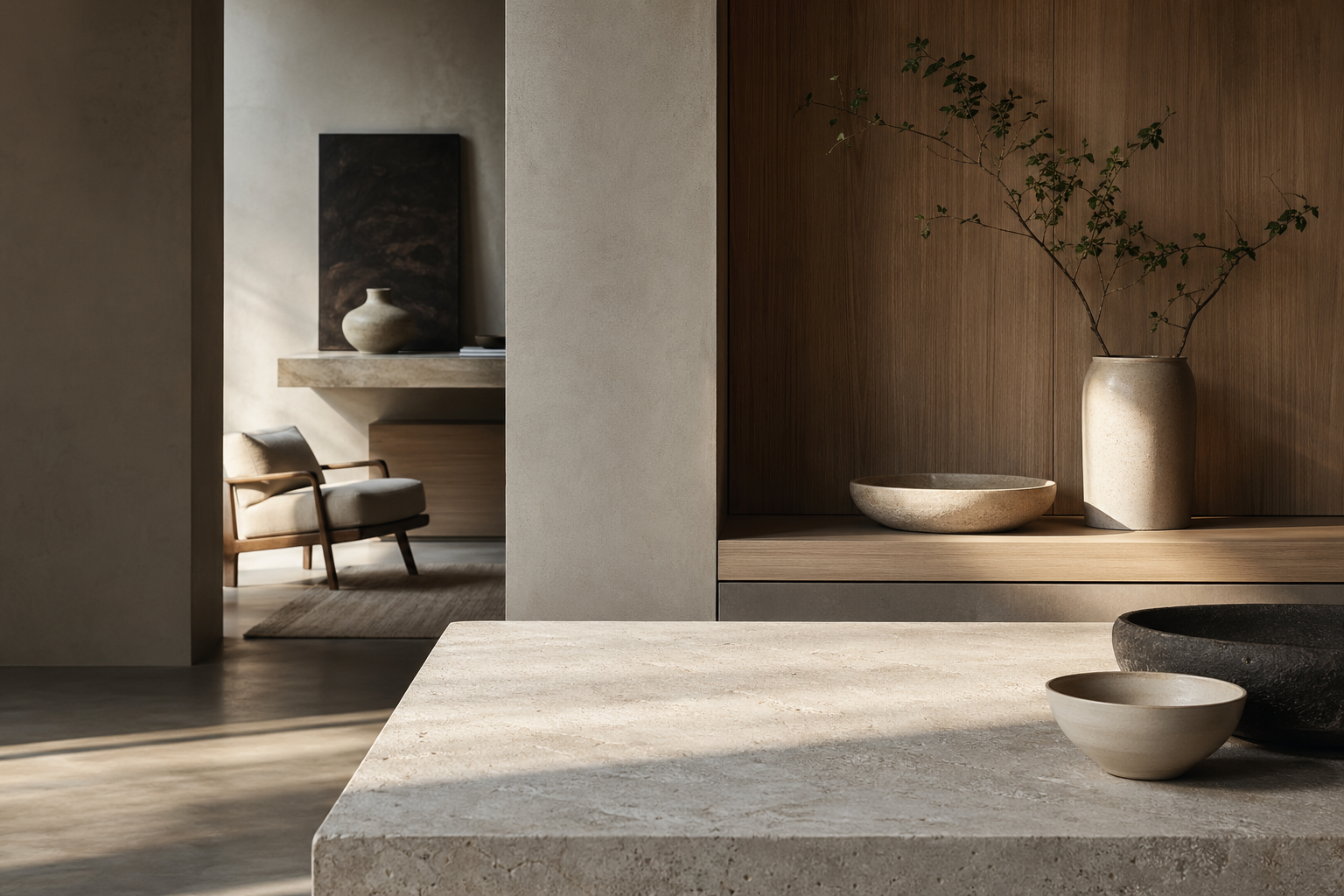
A kitchen inspired by this logic should not imitate a faucet or a chair. It should borrow the discipline behind them. If a cabinet wall needs heavy trim, dramatic hardware, or layered accessories to feel interesting, the base specification is probably weak. Quiet luxury does not mean there is no expression. It means the expression comes from proportion, finish depth, accurate detailing, and confidence in the surfaces themselves.
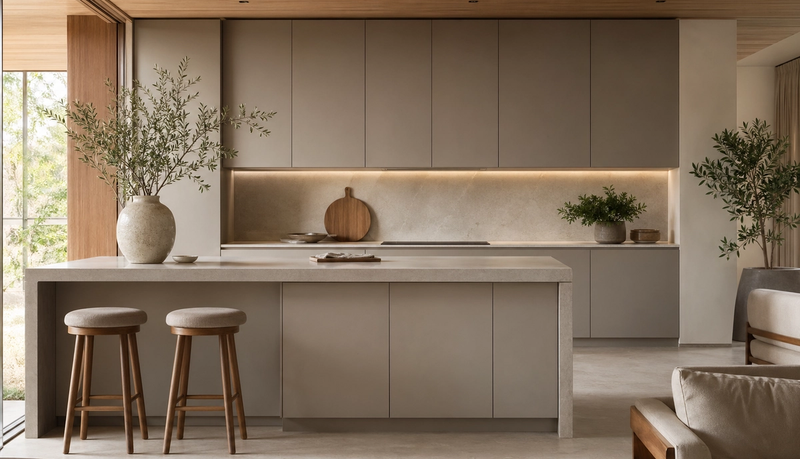
This is where Fadior can translate a design reference into a room strategy. Powder-coated cabinet planes in warm gray or chalk white, paired with oak accents and limestone-toned counters, can feel residential and human without losing durability. The role of the system is to support the hush of the room. The room should feel resolved from a distance and even better when you stand close enough to understand the surfaces.
How did EuroCucina change the reading of minimalist kitchens?
EuroCucina is useful because it shows when a visual trend becomes a market language. The official Salone page still describes the event as the international kitchen benchmark, and the 2026 edition reinforced a shift that has been building for years: the room is becoming warmer, calmer, and more integrated with the rest of the home, but not less engineered. In other words, minimalism is not disappearing. It is learning to sound softer.
That distinction matters because many buyers still hear the word minimalist and think of cold white slabs, sharp gloss, and an over-corrected showroom mood. Today's stronger European rooms are moving in a different direction. The palette is often warmer. Stone is less theatrical and more tactile. Technology is more hidden. Fixtures are more exacting. The kitchen acts less like an isolated machine zone and more like a precise continuation of the architecture around it.
Fadior should read that shift as permission, not pressure. It means the brand does not need to prove seriousness through hardness alone. It can use muted powder coat, warm wood-transfer notes, soft stone pairing, and quieter fittings while keeping the cabinet body durable and glue-free underneath. The trend is not asking for weaker kitchens. It is asking for better translations between material confidence and domestic comfort.
- Material truth
- Material truth is the idea that a surface should communicate what it is doing in the room through its behavior, finish, and touch rather than through decorative disguise or empty marketing language.
| Pairing | Why it works visually | Risk if specified poorly | Best use case |
|---|---|---|---|
| Warm light stone plus soft gray cabinetry | The contrast stays low, so the room reads as one calm volume instead of many separate parts. | Flat value ranges can look lifeless if the surfaces do not have tactile depth or careful lighting. | Open-plan kitchens where the cabinetry needs to merge with living space. |
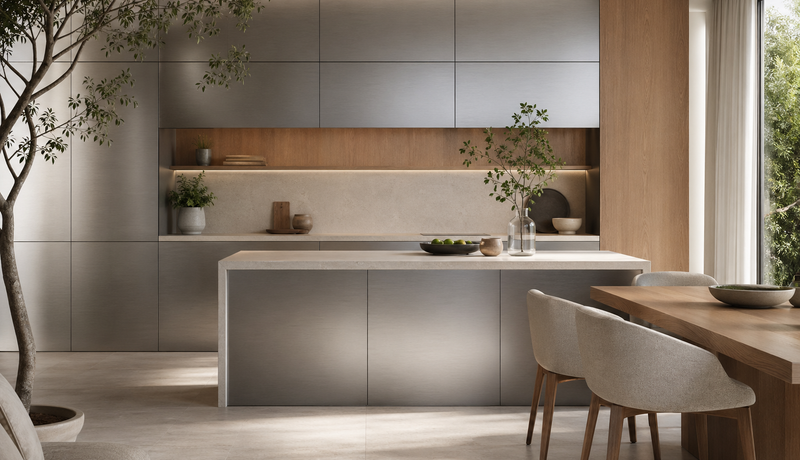
| Oak accents plus pale cabinet planes | Oak introduces natural warmth while pale planes keep the architecture quiet and expansive. | Too much grain variation turns the room rustic instead of refined. | Apartment kitchens that need warmth without visual heaviness. |
| Champagne-toned fittings plus limestone surfaces | Warm metallic accents make the room feel considered without adding loud contrast. | Overuse can turn a calm room into a trend collage. | Luxury kitchens seeking hospitality and softness instead of hard gloss. |
| Dark muted cabinet planes plus soft stone | The room gains depth and gravity while the stone prevents the scheme from becoming oppressive. | If the cabinet body, lighting, and ventilation are weak, the space will feel gloomy fast. | Large rooms with strong daylight and a clear architectural envelope. |
Which material pairings make minimalism feel warm rather than flat?
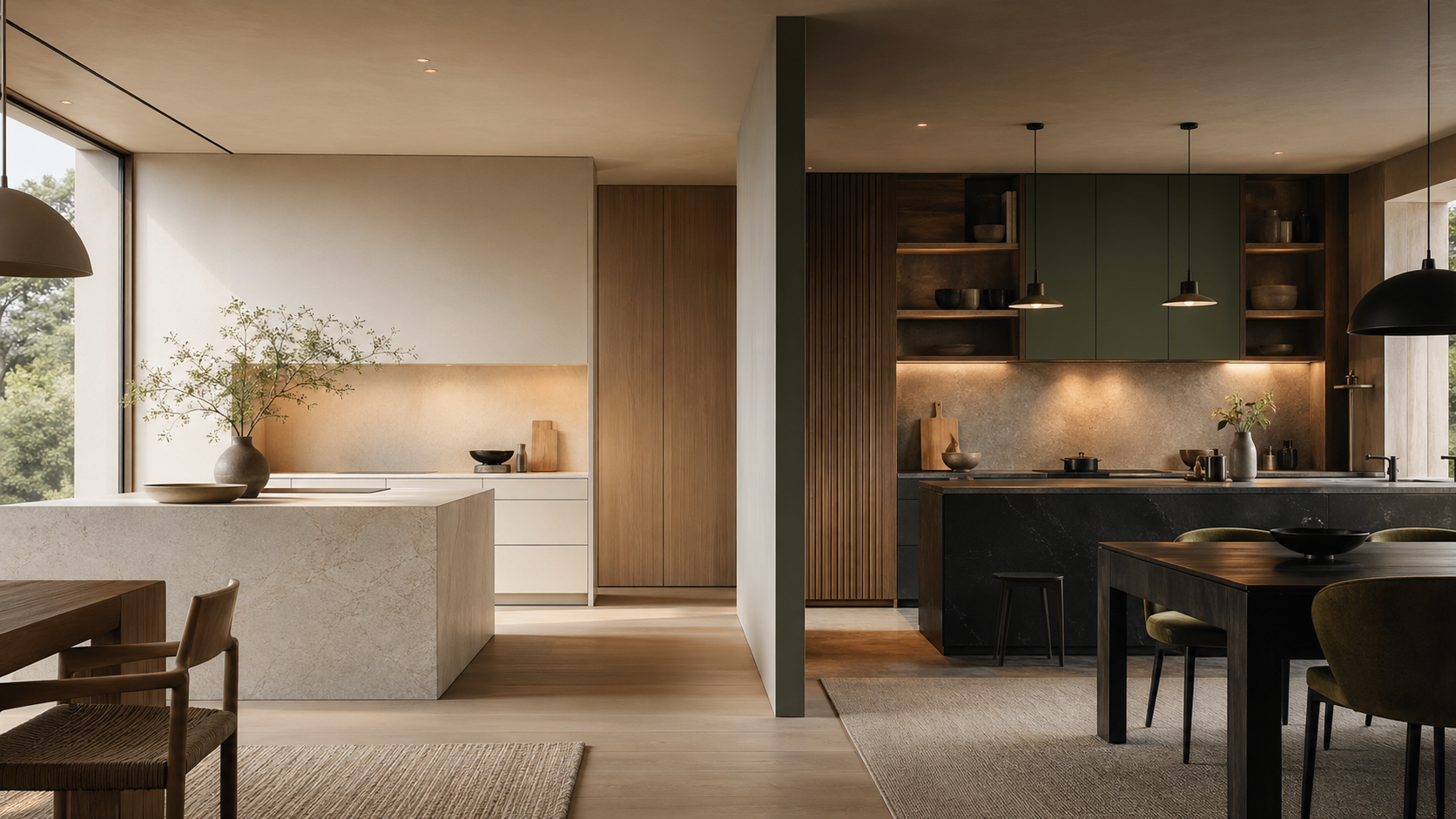
The first rule is to lower contrast before you lower character. Minimalist rooms often become flat when every surface is asked to disappear equally. Better rooms create hierarchy through subtle shifts in tone and texture. Cosentino's own Silestone pages are useful here because they frame HybriQ and HybriQ+ as a technical platform for durable mineral surfaces, not just as a color story. That makes the material a real specification partner for cabinetry rather than a countertop chosen at the very end.
In practice, the strongest pairings usually look calm in photographs but feel rich in person. Warm limestone or low-silica mineral surfaces can sit against broad muted cabinet faces without creating a hard seam between work zone and living zone. Oak notes can warm the composition, but they should act like punctuation rather than taking over the grammar of the room. Champagne-toned or softly brushed fittings can add warmth if they are treated as precise objects, not jewelry.
This is also why the brief's Fantini and Silestone references are worth keeping. They show that quiet materiality is never only about cabinetry. It is about how water points, stone surfaces, cabinet planes, and background architecture speak the same language. The kitchen becomes luxurious when the specification is coherent enough that no single part has to shout.
Why does cabinet-body engineering decide whether quiet luxury ages well?
Minimalist rooms are unforgiving because there is so little visual distraction. When the room is built on broad cabinet planes, long sightlines, and integrated service zones, any weakness in the cabinet body will eventually show up as visual noise. Swelling edges, unstable seams, changing gaps, overworked fillers, or maintenance anxiety all become more obvious when the design language is this quiet.
That is why cabinet-body engineering belongs inside the aesthetic discussion. Fadior's system matters here because it lets the brand make a calm room without relying on fragile visual tricks. One-piece forming, 304-only cabinet bodies, and glue-free framing give the designer more freedom to keep the architecture restrained. The room does not have to defend itself with ornament because the structural logic is already doing the work.
This is the most important bridge between the brief and the business. Quiet materiality sounds like a design concept, but it is really a durability concept wearing a more refined suit. The client who wants a kitchen to feel calm for ten years needs more than a current palette. They need surfaces that will not start arguing with one another after ordinary life, cleaning, humidity, and repeated use arrive.
How should specifiers use Silestone, fittings, and warm finishes without making the room noisy?
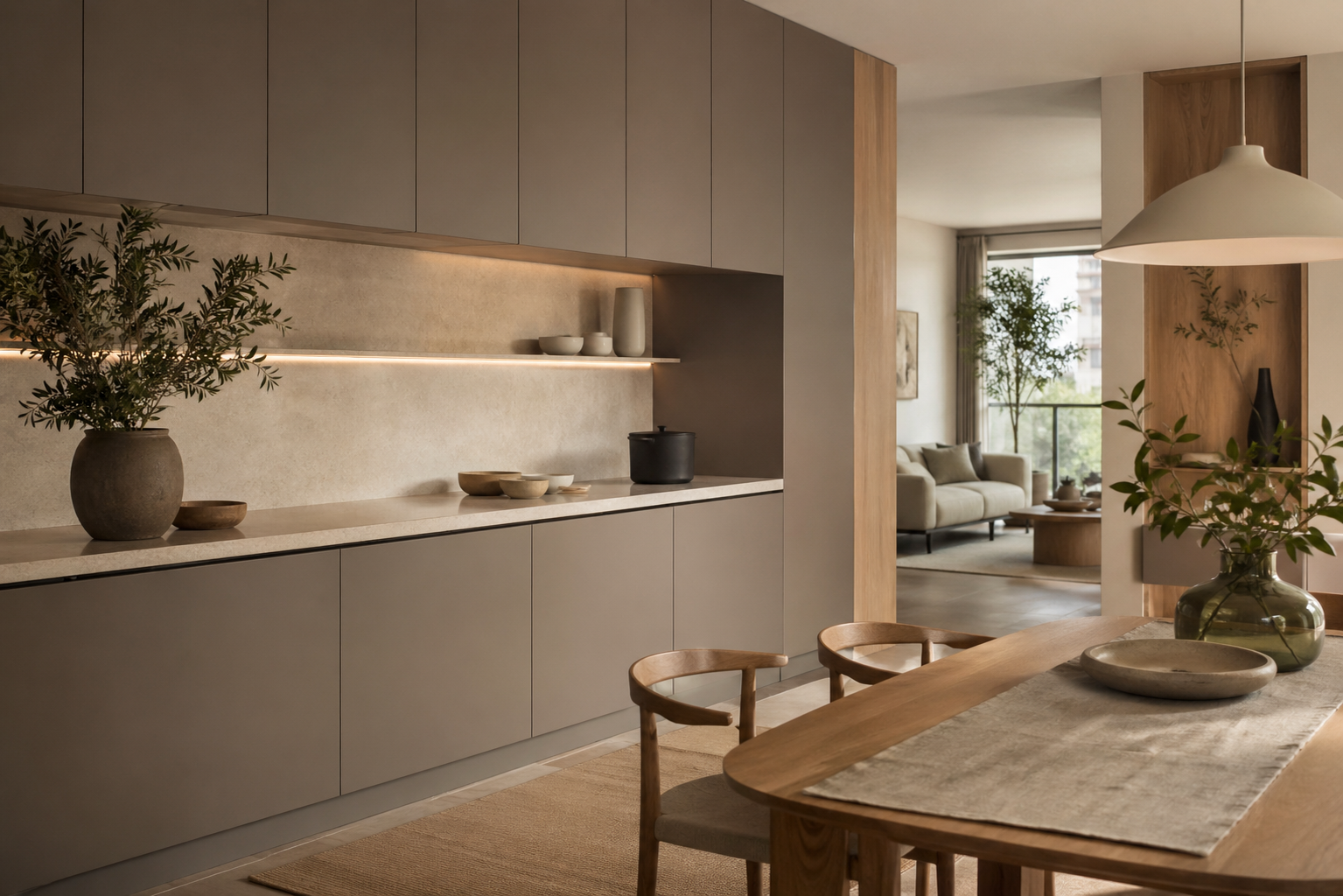
The answer is sequencing. Start with the cabinet body and the room volume. Then choose the countertop surface that gives the room the right tactile weight. Then specify fittings that confirm the level of precision rather than interrupting it. If every layer is chosen at once, the room usually becomes a collage. If the order is controlled, the room gains depth without losing calm.
Specifiers should also ask whether each surface is solving a different job. A low-silica mineral surface can bring tactile density to the horizontal plane. Cabinet faces can control the visual field across the vertical plane. Fittings can introduce a small moment of precision and warmth. Lighting can decide whether the palette reads soft and architectural or lifeless and beige. Once every layer has a role, the room no longer depends on one hero gesture.
This is exactly why Fadior should keep writing from a material-truth angle. It has a stronger story when it explains how a warm room is built than when it simply declares that warm rooms are popular. Buyers already know that taste is shifting. The commercial value is in helping them see which specification decisions keep the room calm after the trend language is gone.
What should a buyer or architect verify before approving a minimalist kitchen?
First, confirm that the room is calm because the architecture is resolved, not because the styling shot was sparse. Ask what the cabinet body is made from, how it is formed, and how the room will behave under real use. Second, review the palette in terms of reflectance and texture rather than color names alone. Quiet luxury usually succeeds when the values stay close but the materials still feel distinct in person.
Third, test every accent against the main thesis of the room. If the fitting, edge condition, or stone pattern becomes the loudest thing in view, the room may have drifted away from quiet materiality into trend collecting. Fourth, verify the maintenance story. A minimalist kitchen is only convincing when it stays disciplined in everyday life, not just on installation day.
The final test is simple. If you remove the flowers, bowls, and styling props, does the kitchen still feel generous, warm, and precise? If it does, the specification is doing its job. If it does not, the room is probably leaning on decoration to explain decisions that the materials should have made clear on their own.
Specification checklist for a warm minimalist kitchen
- Define the main room value range before choosing statement accents, so the kitchen reads as one calm volume.
- Pair broad cabinet planes with a tactile stone or mineral surface that adds depth without harsh contrast.
- Use fittings that confirm precision and warmth, but never let them become the noisiest object in the room.
- Ask for the cabinet-body method in plain language, including whether the structure depends on glued composite board or a formed 304 body.
- Review how lighting changes the palette from morning to evening before signing off the final finish sample.
- Check maintenance implications for every visible surface, because quiet luxury fails quickly when care requirements are hidden.
Direct answer
The Direct Answer
A quiet luxury kitchen is not a plain kitchen. It is a kitchen where material, color, hardware, and structure stay calm under close inspection. Use warm neutrals, low-glare metal, controlled stone movement, concealed or precise handles, soft lighting, and a cabinet body that will not swell or off-gas. Fadior's 304 stainless steel structure lets the visible design stay minimal while the hidden system remains durable and formaldehyde-free.
Frequently Asked Questions
Questions this guide answers
- Does minimalist luxury kitchen design have to look cold?
- No. The strongest current direction is warmer rather than colder. Minimalist luxury kitchen design feels calm when tone, texture, and reflectance are disciplined, not when every surface is white or glossy. Warm stone, quiet cabinet colors, oak notes, and restrained fittings can all belong in a minimalist room if the palette stays coherent.
- Why mention Naoto Fukasawa in a kitchen article?
- He is useful as a design reference because official brand material around his work repeatedly emphasizes clarity, simplification, and the way material quality becomes more visible as form gets quieter. That mindset translates well to kitchen specification, where the goal is to make calm rooms feel intentional instead of empty.
- What is the practical difference between quiet luxury and plain minimalism?
- Quiet luxury still values restraint, but it does not flatten every decision. It uses better materials, stronger tactile hierarchy, and more resolved detailing so the room feels generous without relying on obvious decoration. In kitchens, that usually means warm surfaces, better joins, and more stable cabinet-body engineering.
- Can warm finishes still work with a durable cabinet system?
- Yes. Warmth does not require a fragile construction method. A durable cabinet body can support soft color, muted texture, oak accents, pale stone, and refined fittings. In fact, warm minimalist rooms often depend on stronger structure because there is so little visual noise available to hide technical weakness later.
- What should I verify before approving a quiet minimalist kitchen?
- Verify four things: the cabinet-body method, the palette hierarchy, the maintenance story, and the role of every accent. If the cabinet body, work surface, fittings, and lighting all support the same calm thesis, the room is likely resolved. If the room needs props to feel alive, the specification probably needs another round of editing.
Related reading
Continue exploring the journal.
More guides, whitepapers, and insights from the Fadior journal.
Technical Whitepaper
EuroCucina 2026 Kitchen Trends That Actually Matter
A practical EuroCucina 2026 trend summary with Fadior's interpretation for durable stainless steel kitchen specification.
Technical Whitepaper
Glue-Free Cabinet Construction: How It Works and Why It Matters
A specification guide explaining glue free cabinet construction, how it differs from low-emission composite board, and why architects use adhesive-free formed cabinet bodies in wet, high-value rooms.
Buyer's Guide
Zero-Formaldehyde Cabinetry: What the Label Really Means
A buyer-first guide to zero-formaldehyde cabinetry that explains what EPA and CARB rules cover, where adhesive chemistry still hides, and how to verify a truly glue-free cabinet system.
Related products
Specific products worth reviewing next.
References
Authoritative sources cited in this article
- official EuroCucina and FTK overview
Salone says EuroCucina was first held in 1974 and that FTK was introduced in 2004 as the technology event inside the kitchen biennial.
Salone del Mobile.Milano
- Maruni on Fukasawa as art director
Maruni says it has worked with Naoto Fukasawa as art director since 2010 and frames its collection around durability, warmth, and long-life design standards.
Maruni Wood Industry
- official Naoto Fukasawa designer profile
Maruni positions Fukasawa around design that translates unconscious human behavior into calm, usable forms rather than decorative noise.
Maruni Wood Industry
- Fantini AF/21 concept page
Fantini describes Fukasawa's AF/21 as an exploration of maximum clarity where the aesthetic quality of materials is emphasized through simplified forms.
Fantini Rubinetti
- Cosentino HybriQ technology overview
Cosentino says it launched Silestone HybriQ in 2020, reduced crystalline silica dramatically, and produced the portfolio with HybriQ technology by 2022.
Cosentino
- official Silestone low-silica surface page
Cosentino says all Silestone colors are now manufactured with low crystalline silica content powered by HybriQ+, with current ranges marked by Q10 and Q40 silica labels.
Cosentino
Editorial transparency
Adriana Hale is a composite editorial persona maintained by Fadior Home's editorial team. Articles attributed to this byline are produced through an AI-assisted editorial workflow with human review, and represent the consolidated voice of multiple researchers and contributors.
Ready to specify?