
Luxury Kitchen Supply Chain Audit
Atlas Steels shows why luxury kitchen sourcing needs a written audit of stock, processing, finish control, service geography, and finished-cabinet responsibility.
Direct answer
The Direct Answer
A luxury kitchen supply chain audit is the buyer's check of stock depth, fabrication limits, finish control, and after-service geography before a premium kitchen order is approved. Atlas Steels is useful as a supplier example because it shows how regional material infrastructure can shape procurement choices in Australia and New Zealand. For Fadior, the lesson is not to copy a supplier's catalogue; it is to keep 304 stainless steel cabinet proof separate from sourcing, polishing, tube, sheet, and service-centre evidence.
- Luxury kitchen supply chain audit
- A luxury kitchen supply chain audit is a documented review of stock, fabrication, finish, logistics, and service risk before a kitchen order moves into production.
What should a luxury kitchen supply chain audit prove?
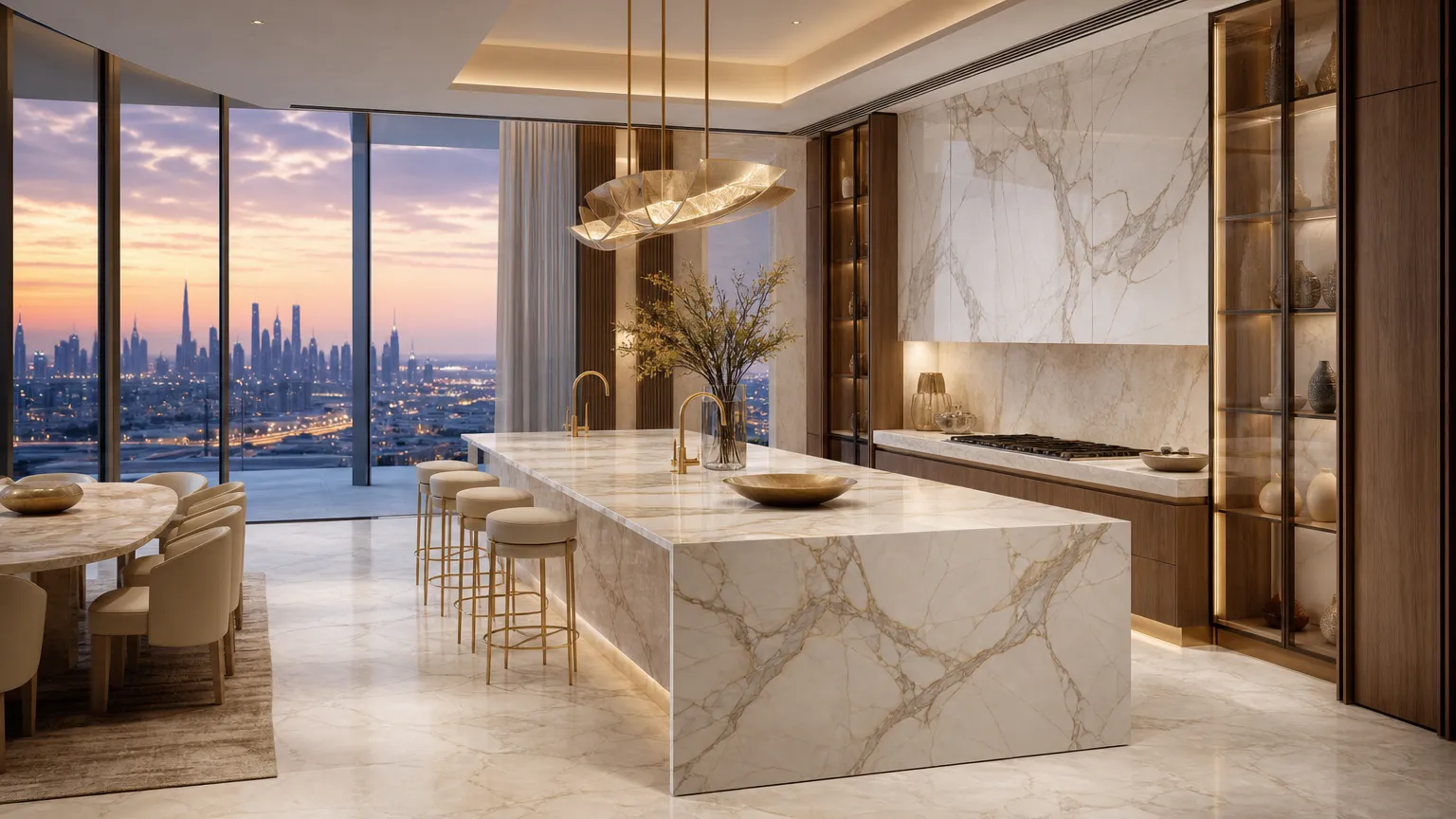
A luxury kitchen supply chain audit should prove that the beautiful decision in the room can survive the less beautiful chain behind it. The buyer sees a calm island, a precise wall of storage, and a finish that belongs to the architecture. The specifier has to ask a harder question: who can provide consistent material, what thickness and finish families are actually available, where polishing or tube work happens, and how replacement pieces will be discussed 5 or 10 years later? Atlas Steels gives the guide a concrete supplier lens because its public material describes an Australian stockist-distributor, 8 Australian service centres, and tube manufacturing in Wellington, New Zealand. Those facts do not make Atlas a kitchen brand, but they do show why regional supply infrastructure matters to architects who do not want every material conversation to begin from scratch. A Fadior audit should make the same distinction. Fadior's cabinet claim is grounded in 304 stainless steel bodies, glue-free construction, surface treatment capability, and a factory process; external suppliers are evidence for procurement thinking, not proof that a finished kitchen has already been engineered.
Why does a regional stockist matter to premium kitchen work?
Regional stockists matter because luxury kitchen projects are rarely just one cabinet order. A villa kitchen may need sheet material for cabinetry, tube or pipe capability for adjacent architectural work, a polished finish vocabulary, and a service path when the owner asks for a future addition. Atlas Steels' published categories include sheet, coil, strip, plate, tube, pipe, fittings, polishing, cutting, and tube manufacturing. That breadth is valuable evidence for a supply-chain conversation, but the specifier still has to translate it into a residential decision. The right question is not whether a supplier carries many product families. The question is whether the finish and form selected for a home can be documented from sample to fabrication to installation. Fadior's role sits downstream of that raw-material conversation: it converts 304 stainless steel into cabinets, wardrobes, vanities, wall panels, and whole-home systems with a defined manufacturing promise. A good audit therefore separates three layers: supplier availability, fabrication route, and finished residential warranty. Mixing those layers creates overconfidence. Separating them gives the owner a clearer approval file and gives the designer a better way to compare local, imported, and factory-integrated options.

| Audit layer | Evidence to request | Risk if skipped | Fadior decision use |
|---|---|---|---|
| Regional stock | 1 current stock route, service-centre geography, and lead-time note | A finish is approved without knowing where continuity will come from | Compare imported cabinet planning with regional supply support |
| Fabrication route | 2 process notes: forming path and finish handling | The drawing assumes capability the supplier does not provide | Keep 304 cabinet production proof separate from raw supply claims |
| Finish control | 3 reference samples under project light | The room approves a mood but not a reproducible surface | Tie sample approval to room, orientation, and care expectations |
| After-service geography | 1 future replacement contact path | A replacement conversation starts after the owner has moved in | Record who owns material, cabinet, and installation responsibility |
| Commercial boundary | 1 written scope split between supplier and maker | A stockist is mistaken for a finished kitchen producer | Explain where Fadior begins and external sourcing context ends |
How should Atlas Steels be used without overstating the source?
Atlas Steels should be used as a procurement example, not as a design authority for a finished kitchen. Its own public footprint points to stockist-distributor activity, product families, service-centre geography, and tube manufacturing capability. That is enough to support a practical article about supply-chain readiness. It is not enough to claim that Atlas controls luxury kitchen outcomes, dictates design trends, or offers finished residential cabinetry. The editorial value is in containment. When a supplier publishes sheet, coil, strip, plate, tube, pipe, fittings, and polishing services, a designer can ask better questions about availability, finish continuity, and regional support. When a finished cabinet brand publishes cabinet categories, surface treatments, patented glue-free construction, and manufacturing scale, the buyer can ask a different set of questions about product responsibility. Keeping those sources in their proper lanes makes the guide more useful. It also protects the reader from a common luxury-specification mistake: treating every strong supplier page as proof that a finished room will be simple to deliver. In practice, the room succeeds only when stock, fabrication, finishing, installation, and after-service are documented together.
Documents to collect before signoff
- 1 governing sample or finish board photographed under the actual room light.
- 2 supplier notes: product family availability and service-centre or manufacturing geography.
- 3 fabrication notes: forming route, polishing route, and finish handling boundary.
- 4 project notes: room location, wet-zone exposure, cleaning expectation, and replacement path.
- 5 commercial notes: who owns cabinet warranty, material sourcing, installation, and future service.
Which supply facts belong in the buyer file?
The buyer file should contain only facts that can guide a future decision. Atlas Steels' 8 Australian service centres are relevant because geography affects conversation speed, sample handling, and future replacement routing. Tube manufacturing in Wellington is relevant because manufacturing location tells a project team that not every item is merely brokered. Public categories for sheet, coil, strip, plate, tube, pipe, fittings, polishing, cutting, and product specifications are relevant because they map the supplier's practical vocabulary. Fadior's 600M RMB smart factory, 60,000+ sqm new facility, 20,000+ monthly unit capacity, and 26,000+ technical production rules belong in the file for a different reason: they describe finished-system capability. A procurement note should not blur those categories. It should say that supplier evidence informs sourcing risk, while Fadior evidence informs cabinet responsibility. This is especially important for international buyers who may see Australia, New Zealand, China, the Middle East, and Southeast Asia in the same project conversation. A crisp file lets the owner approve a room without pretending the global supply chain is invisible.

When should a supplier reference change the specification?
A supplier reference should change the specification only when it changes a real risk. If a page confirms regional service locations, it may affect sample routing, replacement planning, or local project confidence. If a page confirms a product family such as sheet, coil, strip, plate, tube, or fittings, it may affect how the designer discusses adjacent architectural scopes. If a page confirms polishing or cutting services, it may affect finish-control questions. It should not automatically change the selected cabinet system. Finished residential cabinetry still needs room measurement, cabinet-body engineering, door and panel strategy, appliance integration, moisture planning, and a service promise from the maker. That is why a Fadior article should treat Atlas as a useful comparator for supply-chain thinking while keeping Fadior's own manufacturing claims rooted in its factory and 304 stainless steel product system. The decision trigger is simple: use supplier evidence when the risk is availability, geography, or raw processing; use cabinet-maker evidence when the risk is durability, health, installation, warranty, or whole-home fit.
How does this audit help architects in Australia and the Gulf?
Architects working across Australia, New Zealand, the Gulf, and Asia often face a mixed procurement reality. The client wants an international-standard room; the site team wants predictable lead times; the designer wants finish discipline; and the owner wants after-service that does not require reconstructing the entire specification history. A supply-chain audit gives everyone a shared file. In an Australian context, Atlas Steels' geography and product-family breadth make the local material conversation concrete. In a Gulf villa or high-rise context, the same audit logic helps the designer compare regional availability, imported cabinet systems, and the finish expectations of large, light-filled rooms. Fadior fits that conversation as a finished whole-home system rather than a raw-material stockist. Its strongest claim is not that every local supply question disappears. Its claim is that 304 stainless steel cabinetry, glue-free construction, surface treatment, and factory-controlled production can be written into a buyer file with enough clarity to support premium residential decisions across markets.
Why should the audit separate material sourcing from cabinet warranty?

Material sourcing and cabinet warranty are related, but they are not the same promise. A supplier may help a project understand availability, format, and regional support. A cabinet maker must answer for what happens when the material becomes a built-in system: how the body is formed, how surfaces are finished, how the cabinet handles moisture, how installation tolerances are managed, and how future service is handled. This separation matters because luxury kitchens are emotional purchases with technical consequences. Owners remember the room, not the procurement chain, but the room only remains calm when the chain has been documented. Fadior's 304 stainless steel position gives the specification a clear standard: do not borrow supplier authority to inflate a cabinet claim, and do not reduce cabinet engineering to a raw-material catalogue. The audit should put each proof in its lane, then connect the lanes into one readable approval record.
What is the practical checklist before approval?
How should the approval file read after installation?
After installation, the approval file should still read like a useful operating note, not a showroom souvenir. It should tell the owner which room zones were approved, which sample governed the visible finish, why the selected cabinet system was chosen, and which external supplier references were used only for sourcing context. It should also record the 304 stainless steel cabinet baseline, the cleaning expectation, the finish-care boundary, and the route for future additions. This is where many luxury kitchens lose clarity: the design team remembers the decisions, but the second owner, property manager, or service team receives only a beautiful finished room. A supply-chain audit prevents that loss of memory. It keeps Atlas Steels in the file as regional supplier evidence, keeps Fadior in the file as the finished cabinet system, and keeps the owner from confusing stock availability with whole-room performance. The best file is short enough to be read in 10 minutes, but specific enough to settle a question 5 years later.
Frequently asked buyer questions
Buyers often ask whether a strong supplier network means the kitchen itself is automatically safer to specify. The answer is no: it reduces one type of risk while cabinet design still depends on the maker's engineering and warranty. They also ask whether a 304 stainless steel cabinet must look industrial. Fadior's answer is that surface treatments, 3D wood-grain transfer, powder-coated colors, PVD tones, and room composition can make the system read residential. Finally, they ask whether a supplier reference should appear in a luxury article. It should, when it helps explain procurement reality and when the guide clearly states the supplier's role.
Frequently Asked Questions
Questions this guide answers
- Is Atlas Steels a luxury kitchen brand?
- No. Atlas Steels should be treated as a supplier and manufacturing reference, not a finished residential kitchen brand. Its value for this guide is that it makes material availability, service-centre geography, product families, and regional processing capacity easier to discuss.
- Why include a supplier in a Fadior Journal article?
- A supplier reference helps buyers see the hidden side of premium kitchen specification. It does not replace Fadior proof; it shows why stock depth, polishing paths, tube or sheet availability, and future service routing should be checked before a kitchen order moves forward.
- What should a buyer ask before approving an imported kitchen?
- Ask for the governing sample, cabinet material baseline, room-zone map, finish-care limits, regional service path, and a clear split between supplier responsibility and finished cabinet responsibility. Those notes keep the approval practical after the showroom visit ends.
- Does a regional supplier remove the need for factory proof?
- No. Regional supply can reduce availability and replacement risk, but it cannot prove cabinet construction, moisture resistance, surface treatment, or warranty. Factory proof still has to come from the finished cabinet maker and its documented production process.
- How does Fadior keep the material claim precise?
- Fadior should keep the cabinet claim anchored to 304 stainless steel and its own manufacturing process. Decorative finishes, supplier references, and regional sourcing notes can support the specification, but they should not blur the core cabinet performance claim.
Related reading
Continue exploring the journal.
More guides, whitepapers, and insights from the Fadior journal.

Technical Whitepaper
Chromatic Specification Record
A chromatic kitchen specification record gives architects and luxury homeowners a practical way to approve expressive color before production: sample, light, room, care, and 304 cabinet proof in one place.

Buyer's Guide
Light-Reactive Finish Schedule
Colored stainless steel can add depth to a luxury kitchen, but only when sample, light, direction, batch, and care limits are written before production.

Buyer's Guide
Gulf Kitchen Atmosphere Plan
A GCC luxury kitchen needs more than a beautiful color sample. It needs a room-by-room plan that tests finish warmth under daylight, evening hospitality light, humidity, cleaning, and 304 stainless steel performance requirements.
Related products
Specific products worth reviewing next.



References
Authoritative sources cited in this article
- Atlas Steels company source
Company category and navigation source for stockist, product, and services scope.
Atlas Steels home
- Atlas Steels service-centre geography
Service-centre geography source for Australian locations.
Atlas Steels contact
- Atlas Steels tube manufacturing
Manufacturing-service page for tube capability and Wellington context.
- Atlas Steels tube and pipe range
Product family page for tube, pipe, fittings, and polishing context.
Atlas Steels tube and pipe
- Atlas Steels sheet specification source
Product specification page for sheet, coil, strip, and plate documentation.
Atlas Steels sheet and plate specs
Editorial transparency
Sienna Park is a composite editorial persona maintained by Fadior Home's editorial team. Articles attributed to this byline are produced through an AI-assisted editorial workflow with human review, and represent the consolidated voice of multiple researchers and contributors.
Actually delivered
Real homes photographed after handover, not renders.
Ready to specify?