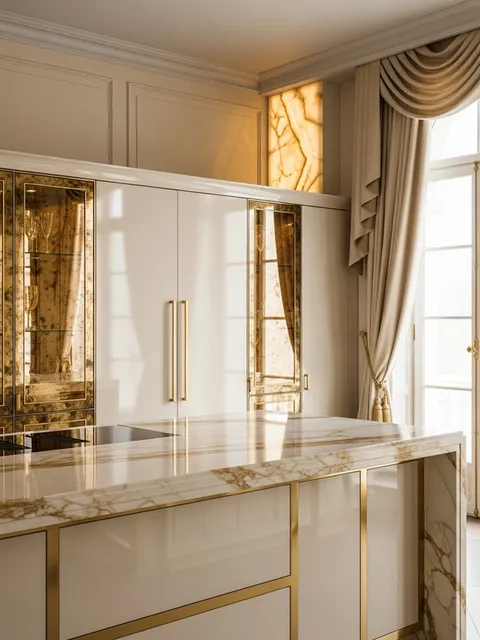
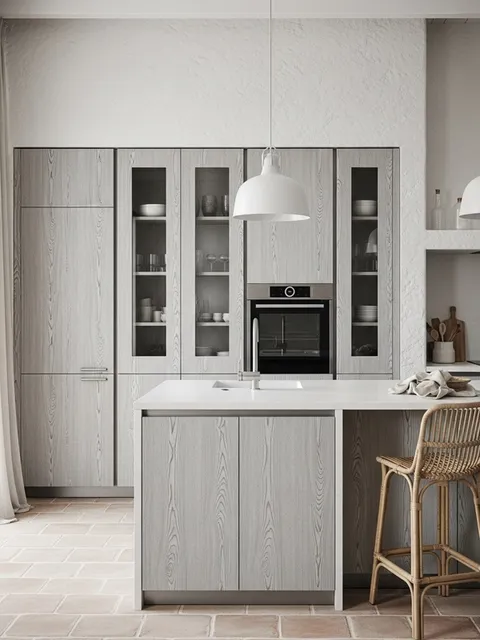
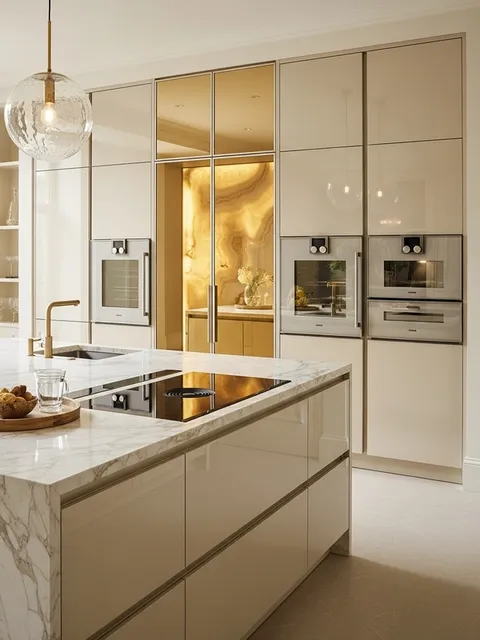
Abyss Kitchen Suite in this configuration is a complete custom kitchen system built around a 304 stainless steel cabinet body, with matte charcoal door fronts framed by brushed stainless steel profiles. It is engineered for residences whose interior architecture reads as calm and material-led, where the kitchen is asked to behave as quiet residential architecture rather than as a row of decorated doors.
In a typical residential plan the suite organises itself around concealed-hardware door faces and precise reveal control, with the matte charcoal field carrying the dominant tone of the room and the brushed stainless steel profiles acting as quiet drawn lines along its rhythm. The matte charcoal doors hold the elevation as continuous dark planes, neither reflective nor matte to the point of looking inert, so the surface reads with subtle depth as daylight moves across the room from morning into evening. The brushed stainless steel profiles outline the cabinet edges and provide a directional grain that catches light along the cabinet line itself, lending vertical and horizontal articulation to what would otherwise be a single dark field. Because all hardware is concealed and the reveal gaps between bodies and doors are held to the same line throughout the elevation, nothing on the door face competes with the contrast between the charcoal field and the brushed steel line. The kitchen reads as refined architecture rather than as cabinetry, and the corrosion-resistant 304 stainless steel body does the structural and the hygienic work behind the visible matte plane. Project-specific storage zoning means each cabinet width, shadow gap, and drawer height belongs to one planned elevation rather than to an accumulation of catalogue modules.
The material foundation is 304 stainless steel, used as the cabinet body itself rather than as a clip-on facing over a wood-based core. This is the same food-safe and corrosion-resistant grade specified in commercial kitchen surfaces, applied here as a structural choice rather than a decorative one. The matte charcoal finish sits on the door fronts as the public-facing surface of the elevation, while the brushed stainless steel profiles articulate the joints, and the structural body behind both is the steel substrate. Because the body is steel rather than particleboard, the kitchen carries dimensionally stable behaviour even in a residence where the kitchen runs hard all year — humid summers, cool winters, steam off a stockpot, slow drips around a sink. The brushed steel profile is finished on the steel itself rather than on a clip-on trim, so the directional grain cannot delaminate at the edges or scratch through to a different colour underneath as brushed-effect laminates eventually do. The matte charcoal finish is held on a steel face that does not flex or absorb humidity, so the surface does not develop the localised dulling that painted wood-fronted doors show at corners over time. Indoor-air performance follows from the same upstream choice: with no particleboard core in the assembly, there is no formaldehyde-bearing substrate to off-gas across the years of use.
Construction discipline is what allows the calm planes of the elevation to stay precise. The cabinet structure is formed through Fadior's Salvagnini panel-bender capability — seamless folded-metal fabrication that produces each cabinet body as a continuous bent steel form rather than as a glued or screwed assembly of flat panels. Because the carcase is folded rather than glued, there is no adhesive in the structural assembly to soften under heat, off-gas into the room, or telegraph through the matte charcoal finish over a decade of humidity cycling. Concealed soft-close hardware sits behind the door faces, with precise reveal control holding the gap between body and door to a consistent line; nothing visible rides on the panel front, which is what allows the matte charcoal field to read as a continuous architectural plane. Customisation in dimensions, storage zoning, colours, and surface finishes is applied at the planning stage rather than as a series of post-hoc adjustments, so every reveal line and every drawer width is part of a single planned elevation. Fadior's in-house metal research capability owns the steel substrate, the folded body geometry, the concealed soft-close integration, and the surface finishes as a single design discipline rather than as parts assembled from competing sources.
In daily use, this construction strategy reveals itself in quiet ways. The matte charcoal surfaces wipe clean of everyday cooking spatter without absorbing the colour of the spill, because the finish sits on a non-porous steel face rather than on a paper layer. The brushed stainless steel profiles register the working life of the kitchen as a soft directional patina along their grain rather than as visible damage; the grain itself is what carries the visual character, so light handling does not change how the profile reads. Pots placed firmly on the counter transmit a duller, lower note than they would into a wood-based carcase, because the steel envelope is denser and damps high frequencies more readily. Steam rolling off a pot does not reach an exposed paper edge anywhere in the field, because there is no paper edge to reach — the cabinet body is steel from inside to outside. The food-safe behaviour of 304 means there is no chemistry migrating into ingredients from a printed or laminated face, and the corrosion-resistant nature of the substrate means the steel itself does not stain or rust even after sustained exposure to acidic spills around the cooking zone or the sink. Reveal lines remain consistent year after year because the carcase does not swell with seasonal humidity.
Over time, the absence of adhesive in the structure is the design's deepest economic argument. The glue-free folded-metal carcase removes the failure modes that end most fitted kitchens early — softening at the joint where adhesive meets heat, swelling at the toe-kick where moisture reaches an exposed edge, the slow telegraphing of formaldehyde through a sealed indoor environment, the cumulative drift of a wood carcase under seasonal humidity. Because the body is steel rather than particleboard, the cabinetry holds its dimensional stability across decades of seasonal humidity shifts that cause wood-based carcases to develop sticking doors and drifting reveals. The matte charcoal door faces and brushed stainless steel profiles age in step with the structural body underneath because they are part of the same steel system rather than a coating sitting on a different material with a different rate of seasonal movement. Washable surfaces, clean indoor-air performance, and long-term dimensional stability are not three separate claims but three consequences of the same upstream choice to make the body of the kitchen out of 304 stainless steel and to fold it rather than to glue it. Maintenance over the working life of the suite is correspondingly low: regular wiping for the matte charcoal field, grain-direction cleaning for the brushed steel profiles, and the modest mechanical attention that concealed soft-close hardware normally needs.
Read across the elevation, this configuration of Abyss is a study in calm material restraint — a 304 stainless steel architecture given matte charcoal doors and brushed stainless steel profiles, held together by Fadior's seamless folded-metal construction and concealed soft-close hardware, where the kitchen ages as one continuous material rather than as a layered assembly that drifts apart over time.