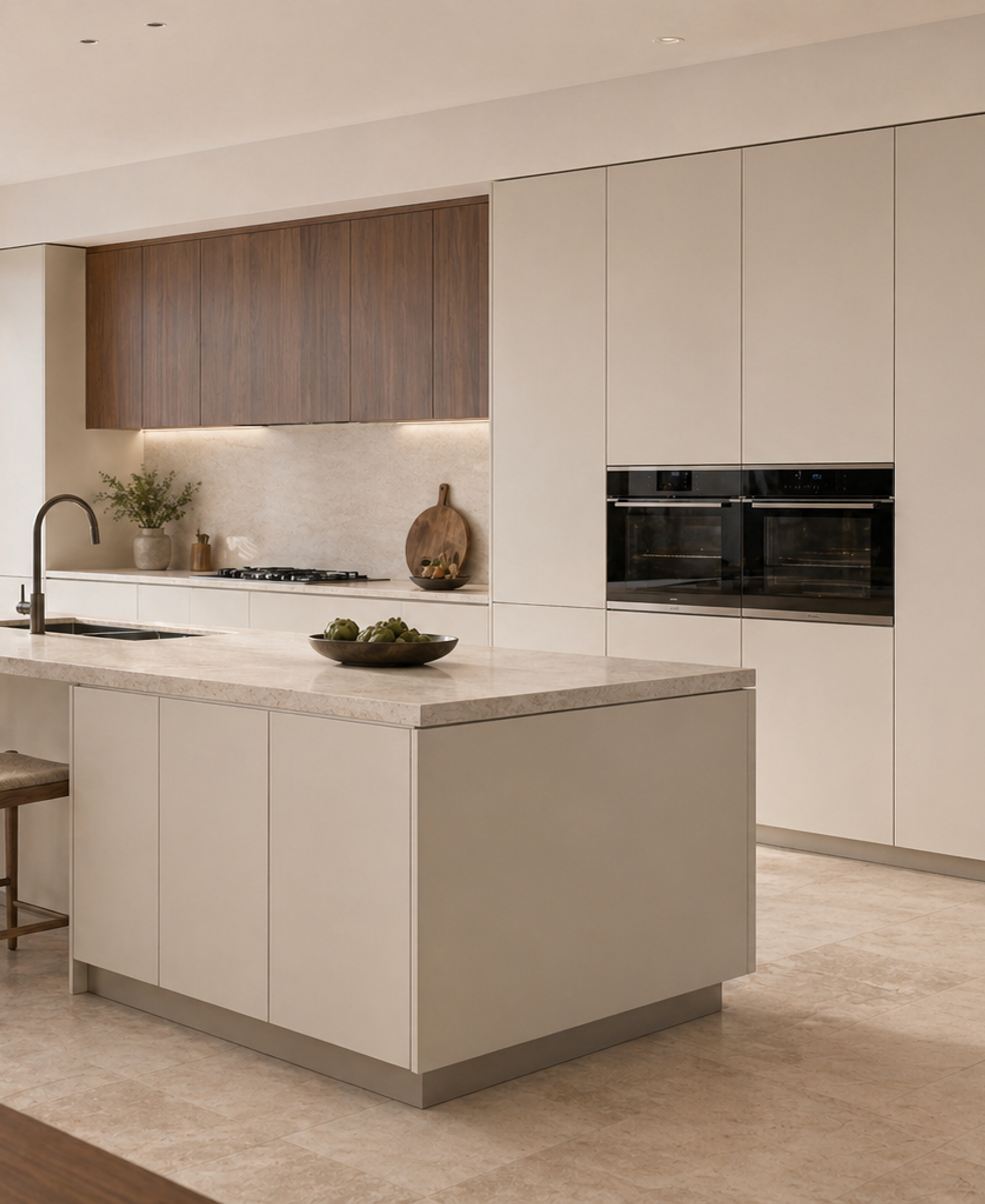
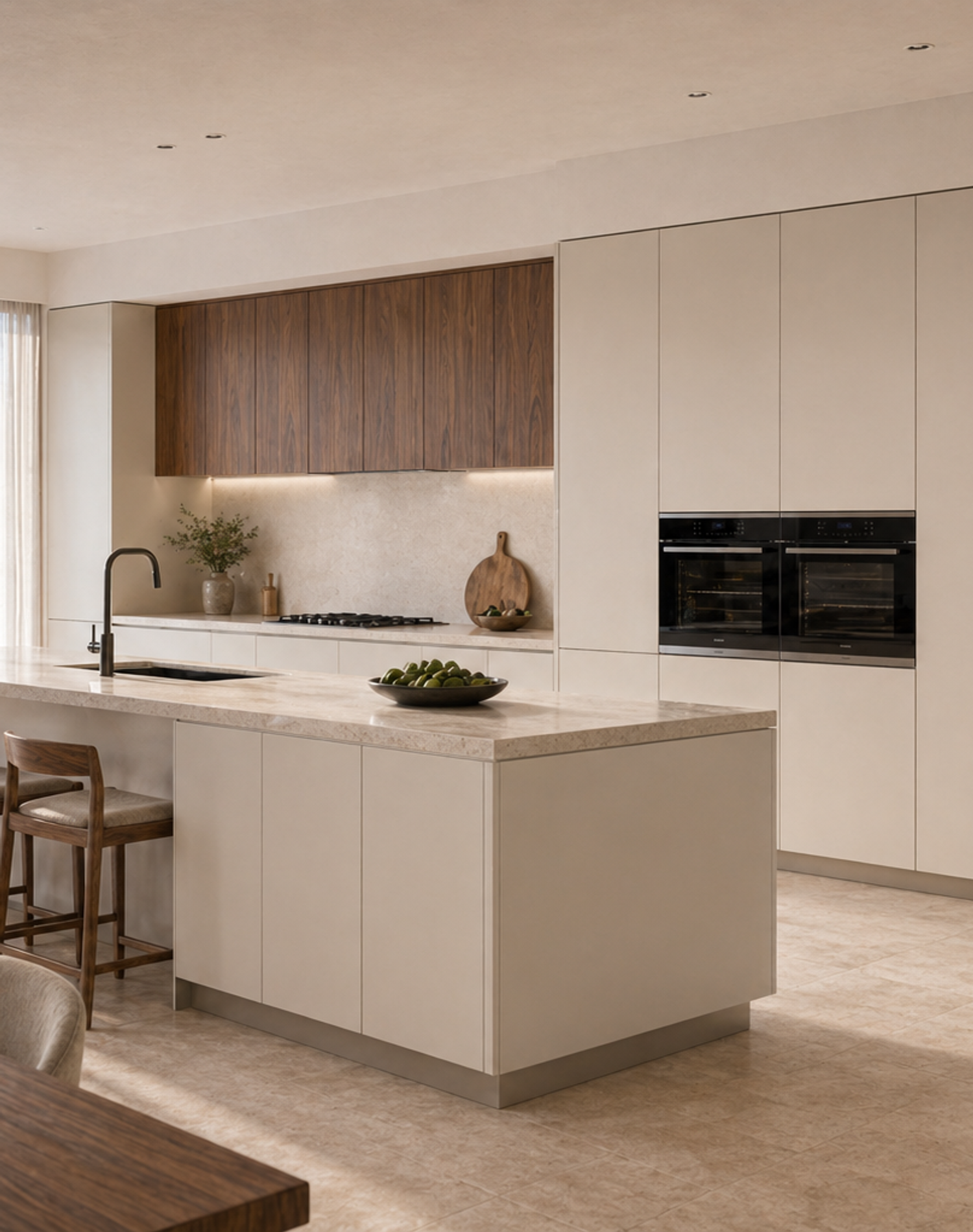
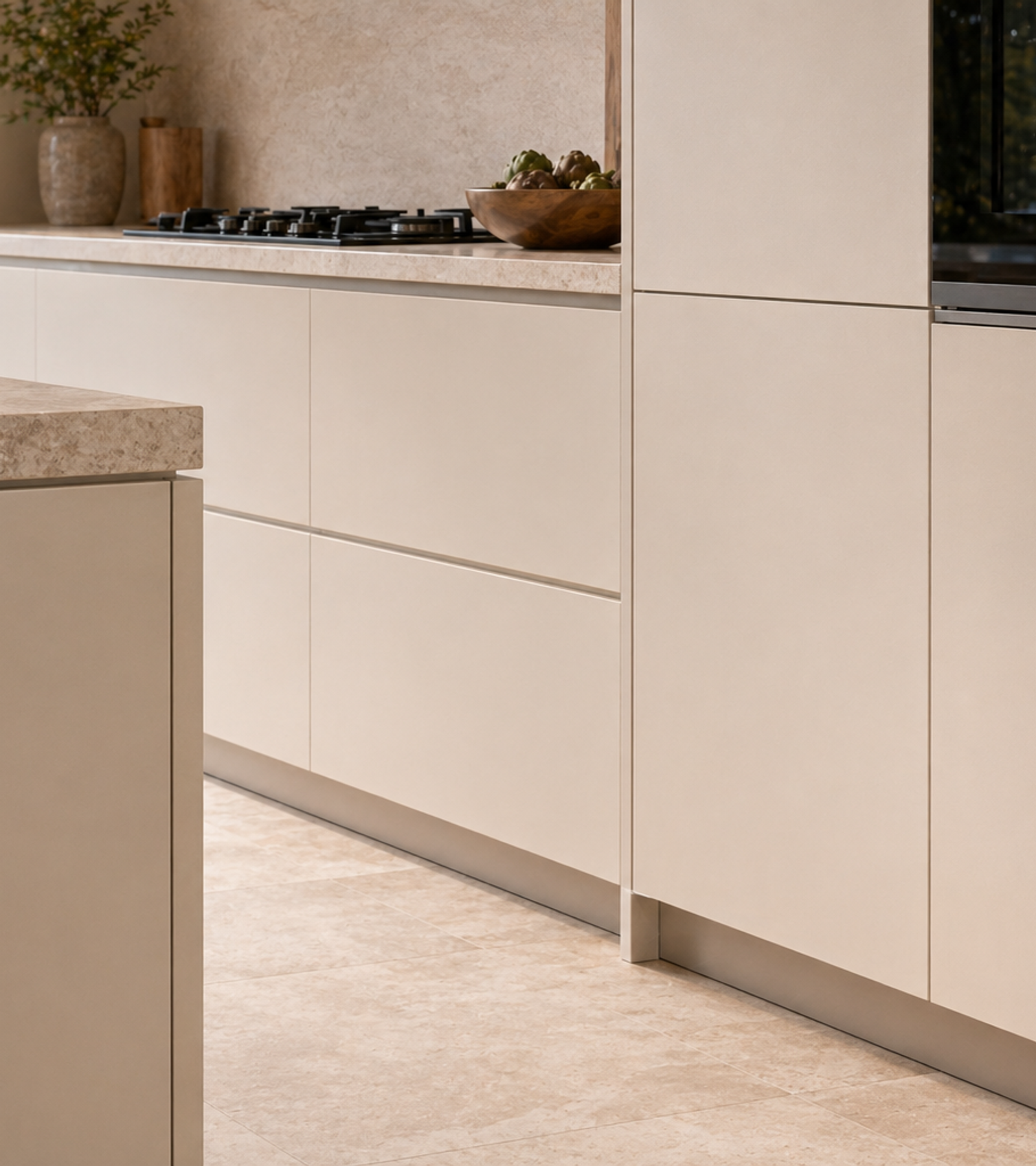
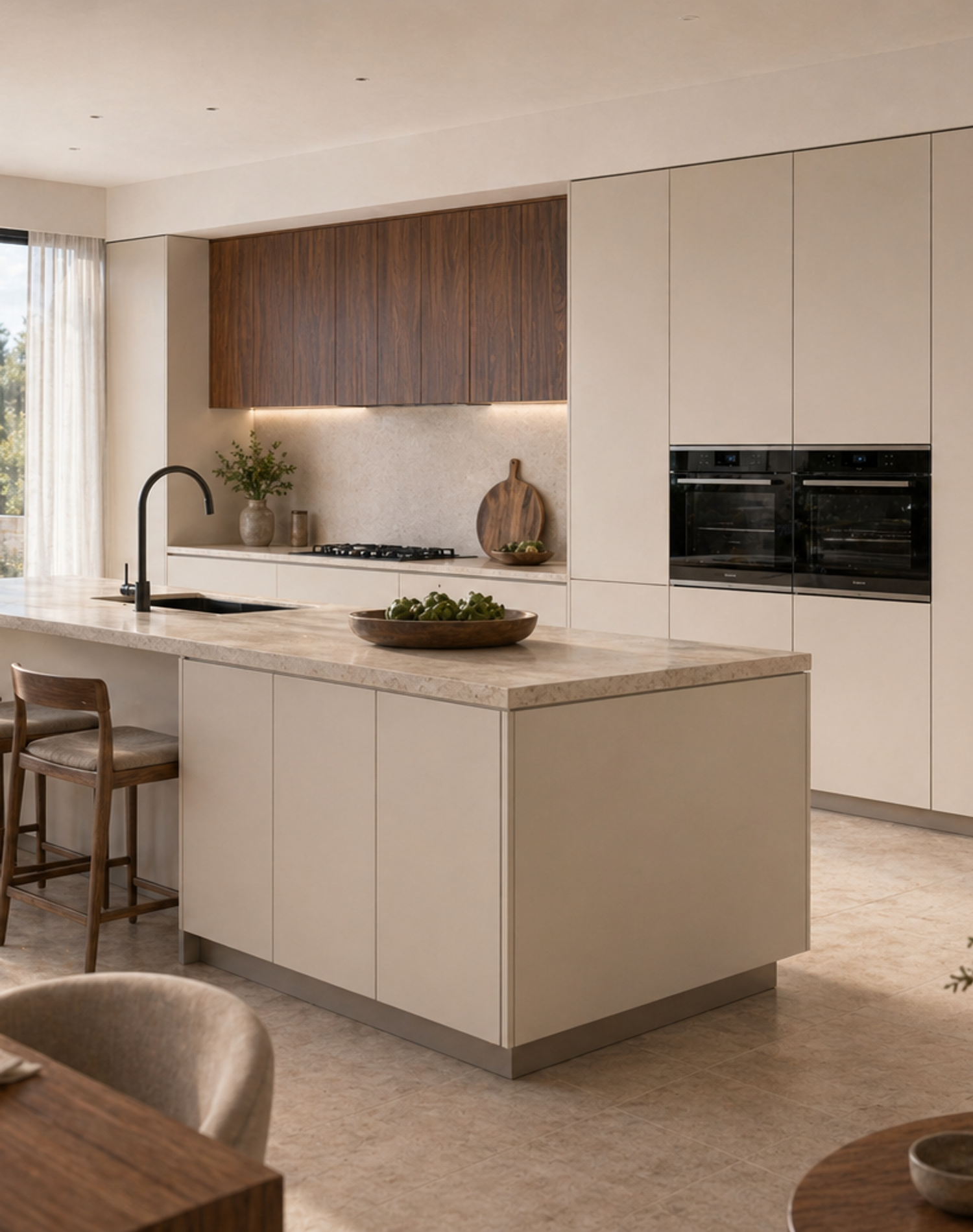
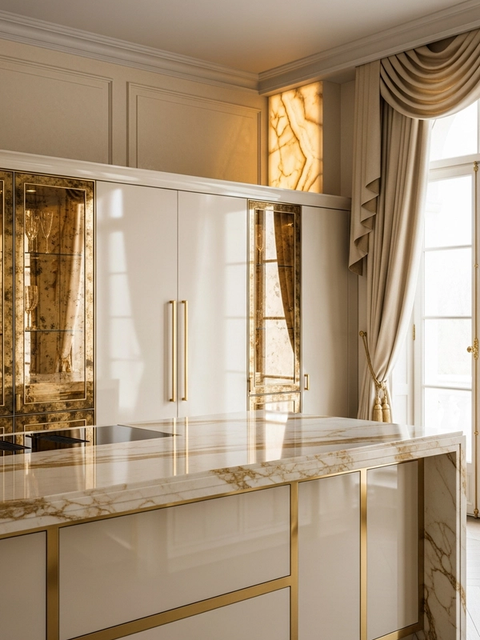
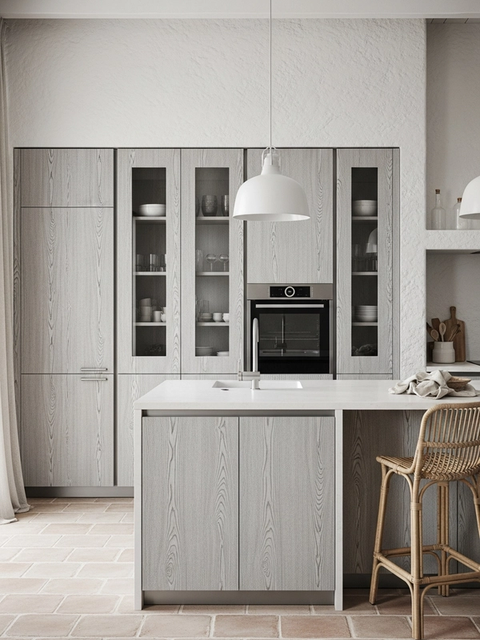
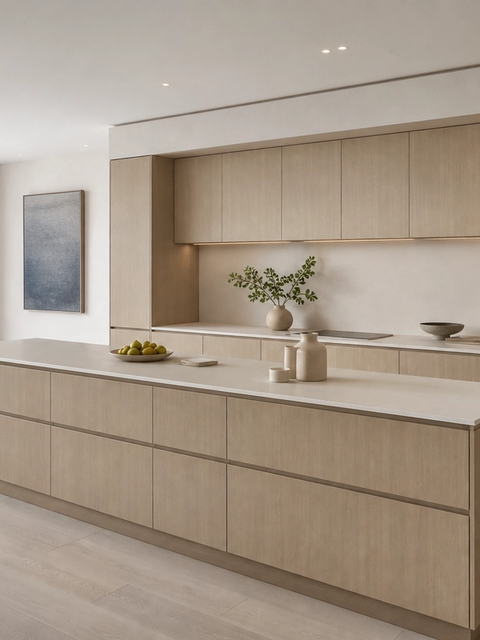
The pearl-toned finish direction is central to that outcome. Frameless Pearl Utility Spine is not a glossy white showroom idea. It is a warmer, quieter interpretation of a modular kitchen where pale fronts, stone surfaces, and measured walnut notes work together to keep the room bright but grounded. The eye reads longer planes, fewer visual breaks, and a calmer storage rhythm, which is exactly why frameless systems have become more attractive in high-end residential design. They allow the room to feel more intentional while also giving planners more freedom to tune drawer depth, pantry width, island balance, and appliance integration. Fadior translates that modular advantage through its own whole-home cabinetry language rather than borrowing generic European cues. The suite still carries the brand's 304 stainless steel, glue-free, long-life construction logic, but the visible result feels softer and more approachable for family living. That is valuable for buyers who want advanced planning and premium materials without a kitchen that looks overly severe or formally commercial.
Planning value is where the suite becomes a strong answer for real buyer intent. Homeowners searching for modular luxury kitchen cabinets are usually asking three things at once: will the room look cleaner, will it store better, and will it remain comfortable for constant daily use? Dream Home answers yes by giving the kitchen a clearer work sequence. The utility spine holds the heavier functional load, the island stays more open and social, and circulation can move around both without the room feeling congested. That matters when a kitchen must handle school mornings, serious cooking, quick reset cleaning, and evening hosting without constant friction. The frameless system also helps storage become more precise. Drawers, pantry doors, integrated tall units, and counter-adjacent zones can be organized with less wasted visual and physical space than bulkier face-frame approaches. In other words, the room does not just look cleaner in photographs. It becomes easier to use at the exact points when an active family kitchen is most likely to break down.
The 304 stainless steel cabinet body gives that modular story a stronger foundation than many finish-first competitors can offer. Frameless planning is often marketed as a design upgrade alone, but homeowners eventually live with humidity, steam, wipe-down cleaning, and long-term alignment issues rather than slogans. Fadior's stainless steel structure makes the suite more persuasive because the planning and the material platform support each other. The clean lines are not sitting on top of a vulnerable adhesive-heavy core. They are supported by a glue-free cabinet body engineered for kitchens that work hard every day. That helps the room stay visually precise longer, and it also supports a healthier indoor-air argument for buyers who care about what sits behind the visible surfaces. In practice, this means a kitchen that is easier to trust. The owner gets the directness and flexibility associated with frameless modular systems, but with a more durable construction logic than many imported or design-led alternatives that treat structure as secondary to appearance.
Customization turns the suite from a strong concept into a highly usable project-specific kitchen. Fadior can rebalance island length, utility-spine density, pantry depth, sink and cook zone relationships, appliance housing, breakfast storage, and finish warmth according to the household's rhythm. Some homes need a stronger prep bias with more tall storage. Others need a sociable island with lighter perimeter weight. The suite can also shift toward a slightly darker or more stone-driven mood while preserving the same frameless logic and family-friendly calm. This matters because modular luxury should not mean fixed catalog living. It should mean better underlying systems that can still be tuned to the owner's habits. Dream Home is positioned exactly that way. It gives the buyer a kitchen that reflects the current best direction in high-end cabinetry design while staying grounded in Fadior's specific strengths: 304 stainless steel, custom planning, and a finish language that feels refined rather than trendy.
One of the clearest benefits of this approach is that the room continues to feel composed even when life is not perfectly staged. Family kitchens are rarely empty for long. Small appliances, school-day routines, groceries, and quick meals all place pressure on the layout. Dream Home is designed so the kitchen can absorb those pressures without losing its visual order. The utility spine pulls more of the practical burden into a controlled service line, while the island remains clearer for prep, conversation, and short-form dining. That means the room resets faster after use and stays more pleasant during use. For buyers comparing modular kitchen systems, this is a more meaningful luxury signal than a dramatic showroom gesture. A kitchen that stays calm under pressure often proves more valuable than one that only looks clean when untouched. Dream Home is specifically built to deliver that everyday steadiness.
This matters in conversion terms because many homeowners are no longer buying kitchens only for visual status. They want a room that supports repeated family use without feeling over-programmed or visually tired. Dream Home turns that requirement into a concrete product answer: cleaner modular storage, calmer movement, and a stronger structural base behind the finish. It keeps the kitchen feeling composed when the household is active, not only when the counters are empty, rushed, or noisy, and easier to reset afterward.
From a search and conversion perspective, Dream Home gives a direct answer to the query implied by the brief: what does a luxury frameless modular kitchen look like when it is also credible in materials, zoning, and daily performance? It looks like a room where storage and movement are cleaner, the finish palette is more edited, and the cabinet body is built for years of use rather than for brochure language alone. Dream Home therefore serves both specifiers and homeowners. Designers can point to a modular planning logic that solves practical layout problems, while homeowners can see a kitchen that feels brighter, calmer, and more durable in everyday life. The suite does not romanticize modularity as a trend. It presents it as a better operating system for a luxury kitchen, then backs that system with the structural discipline of a 304 stainless steel cabinet body. That combination is what makes the suite relevant now and resilient well beyond a passing finish cycle.