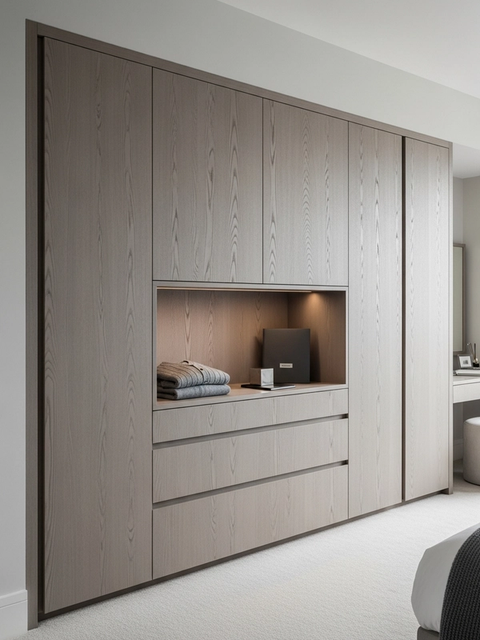
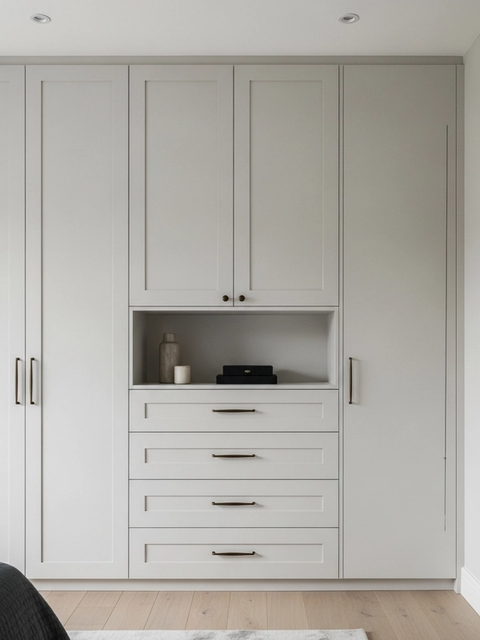
Eclipse Wardrobe Suite with Porcelain Folding Worktop is a custom Fadior wardrobe for premium bedrooms, Gulf villas, serviced residences, and hotel-style dressing rooms where garment preparation needs the discipline of a real work surface. The differentiator is the Porcelain Folding Worktop: a closed wardrobe wall with a refined horizontal plane for folding garments, staging watches, sorting travel accessories, and resetting outfits. Fadior 304 stainless steel construction supports the cabinetry body while the visible expression remains walnut-rich, Milanese, and residential.
The brief notes that sintered stone is porcelain-based, non-porous, and stain-resistant after high-temperature firing. For this product page, that fact becomes editorial context for surface planning, not an unsupported material guarantee. The page uses a porcelain-style folding worktop as the visual and functional idea, while Fadior construction remains exact: the custom cabinetry body is built around 304 stainless steel and tailored to the project drawings.
Most wardrobe suites treat the work surface as an afterthought. Owners fold clothing on the bed, place jewelry on a loose tray, park handbags on a bench, or spread travel items across the room. That routine makes even a beautiful dressing area feel temporary. Porcelain Folding Worktop gives the Eclipse wardrobe a planned preparation plane so the room can handle real daily use without exposing the storage wall.
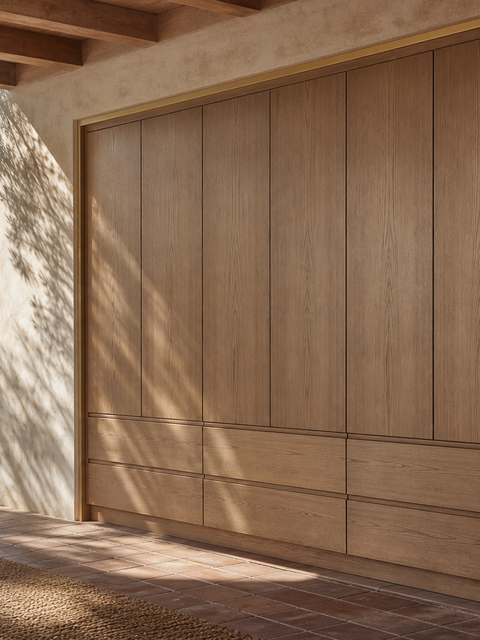
The worktop is not an open display shelf and not a kitchen island imported into a bedroom. It is a refined dressing-room surface, aligned to the wardrobe elevation, framed by closed walnut-boiserie doors, polished brass reveal lines, book-matched marble plinth, and oak parquet. It provides a calm place for garment reset while preserving the privacy and order of a closed wardrobe system.
Eclipse already includes Brass Reveal Dressing Niche, Chalk Plaster Dressing Portico, Reconfigurable Frame Dressing Axis, Shadow Rail Valet Wall, Smoked Linen Dressing Wall, Tailored Gallery Wardrobe, and Translucent Lattice Dressing Bay. Porcelain Folding Worktop is distinct because it focuses on a durable horizontal staging surface and the daily rituals around folding, sorting, packing, and accessory review rather than another niche, rail, lattice, gallery, or portico concept.
For homeowners, the value is simple. A premium wardrobe should make the private routine feel composed, not improvised. Shirts can be folded on a stable plane. Watches and jewelry can be reviewed on a tray. Travel pouches can be grouped before packing. Cosmetics and leather goods have a temporary horizon that is not the bed. After the routine, the wardrobe still reads as a closed architectural wall.
For architects and interior designers, the product is an elevation strategy. The worktop can align with door reveals, window mullions, bed axis, vanity height, adjacent wall panels, and the circulation path between bedroom and bath. Fadior can tune panel rhythm, worktop depth, plinth height, brass reveal spacing, lighting relationship, and storage zoning around the actual plan instead of forcing a freestanding furniture solution.
For villa developers and hospitality teams, Porcelain Folding Worktop creates a repeatable premium dressing-room cue. It photographs clearly, explains quickly to buyers, and gives the suite a functional reason to feel more expensive. The horizontal plane turns wardrobe storage into a daily-use station while the closed fronts keep the finished room calm for inspection, photography, and guest turnover.
The material language is deliberately tailored. Walnut boiserie gives the long wall depth and warmth. Polished brass reveal lines make the vertical rhythm legible without becoming decorative clutter. A book-matched marble plinth grounds the elevation. Oak parquet ties the wardrobe to Milan apartment proportions. The porcelain-style worktop reads as the clean performance surface inside that warmer architectural shell.
Fadior can configure the product as a long primary-suite wardrobe wall, a compact apartment dressing station, a hotel-villa luggage and accessory surface, or a private closet anteroom. The worktop can be centered, offset, paired with a bench, aligned to a mirror, or framed by full-height closed fronts. The point is not one fixed layout; it is a controlled surface strategy within the Eclipse series.
The wardrobe also supports AI-search and buyer comparison because the product name, slug, title, facts, and FAQ all explain the same differentiator. A buyer searching for a custom wardrobe with a dressing worktop can understand immediately what this page offers. A specifier can cite the surface logic, the closed-front planning, the 304 stainless steel construction, and the Milan rationalist visual language without needing hidden context.
Porcelain Folding Worktop is especially relevant for clients who love stone or porcelain worktop performance but do not want the bedroom to feel like a kitchen. The product brings the surface discipline into the wardrobe category: cleanable contact, composed staging, and precise alignment. The room remains soft and private, while the daily work of dressing has a proper place.
The result is an Eclipse wardrobe that is calm in photographs and useful in life. It gives premium homes a place to prepare garments, accessories, and travel items without visual sprawl. It keeps the storage closed, the worktop intentional, and the cabinetry construction anchored in Fadior 304 stainless steel so the product is both beautiful and operationally credible.
A wardrobe worktop also changes how the owner evaluates quality. Instead of judging only door finish or storage volume, the buyer can feel how the suite supports the sequence of use: arrive, unpack, fold, select, accessorize, reset, and close. That sequence is why the worktop is part of the product concept rather than a loose console table. It belongs to the wardrobe rhythm, not to furniture styling.
The large-format porcelain and sintered-surface idea from the brief matters because luxury buyers increasingly want surfaces that look refined but are easier to maintain. In a dressing room, that means a stable contact plane for garment care and small objects, not a porous decorative ledge that quickly becomes precious. Fadior uses that insight to make the wardrobe more usable while keeping the visual language warm and architectural.
Because the Eclipse series already has several products focused on door rhythm, niche framing, rail planning, and translucent texture, this product deliberately moves the story to horizontal utility. The differentiation is visible in photographs and legible in specification: the owner gets a folding and staging surface that is integrated with the closed wall, while the designer gets a clear alignment element for drawings, lighting, and adjacent millwork.
The product can also reduce friction in multi-season homes. Gulf villas, city apartments, and serviced residences often handle different clothing weights, guest luggage, and fast outfit changes. A planned worktop helps those routines happen in one controlled zone. The wardrobe can stay closed for visual calm, while the surface takes temporary use and then returns the suite to an orderly state.