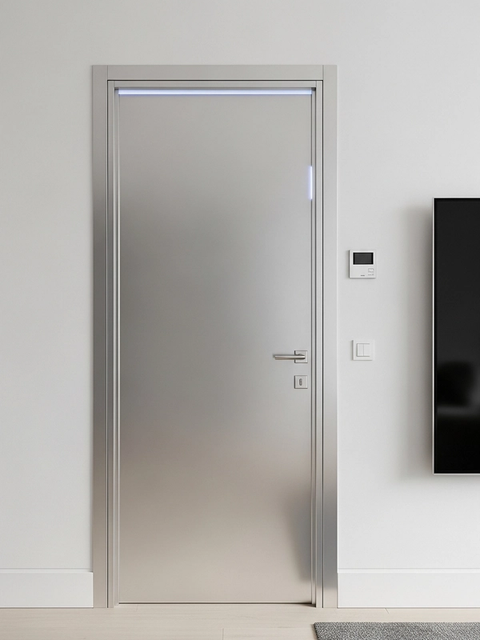
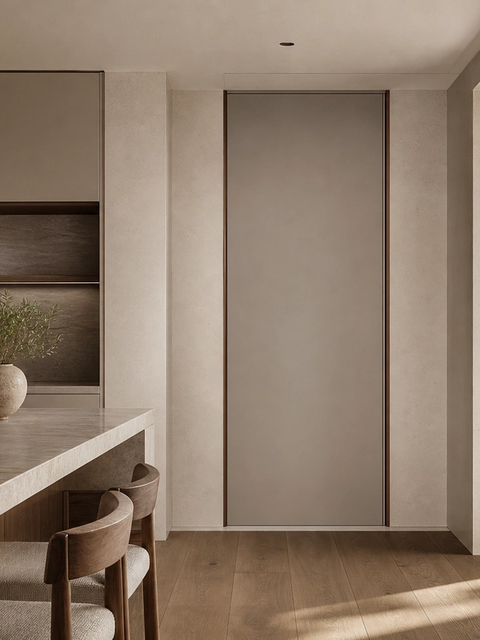
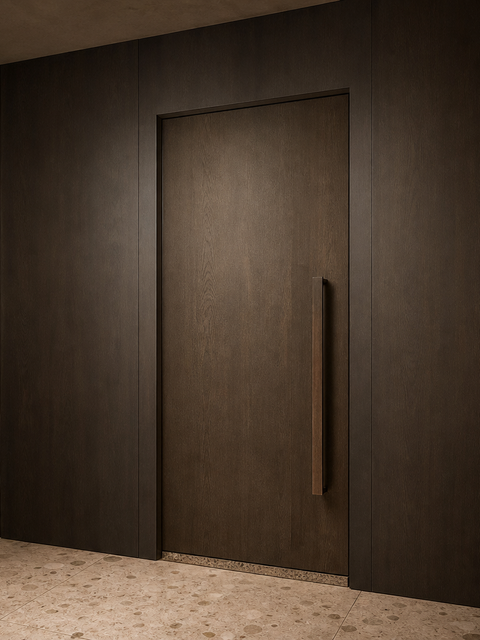
Silhouette Interior Door Suite with Sculptural Fin Passage Screen is a custom Fadior product for Gulf villas, penthouses, and boutique residences where the kitchen, dining room, and private hallway need separation without visual heaviness. The differentiator is the Sculptural Fin Passage Screen: a closed warm-grey satin flush door paired with walnut fins, a pale stone threshold, and concealed 304 stainless steel cabinetry logic. It turns a normal interior doorway into a calm architectural filter, so the passage reads as part of the home rather than a simple door slab.
Interior doors in Gulf homes carry more work than many buyers expect. They divide cooking, hosting, staff circulation, family zones, and private rooms while facing air-conditioning cycles, fine dust, heavy use, and repeated cleaning. A standard timber door may solve privacy but miss the architectural opportunity. Fadior uses 304 stainless steel structure behind the visible finish so the passage can keep alignment, while the warm-grey satin and walnut edge treatment keeps the door residential.
The fin screen gives the product its identity. It is not an open mechanism, a decorative grille, or an exposed construction detail. The fins act as a fixed sculptural exterior screen beside the closed flush door, making the threshold feel softer and more intentional. From the kitchen side, the screen gives depth. From the dining side, it creates a gentle transition into the private hallway. The result is quiet spatial choreography instead of a hard stop.
Silhouette already includes Bronze Threshold Pivot Sequence, Carrara Panel Passage Slab, Cypress Lattice Threshold Door, Reeded Slate Pocket Door, Ribbon Reveal Pivot Portal, and Walnut Edge Gallery Portal. Sculptural Fin Passage Screen is different because its main idea is not a pivot sequence, stone slab, lattice threshold, reeded pocket, ribbon reveal, or walnut edge gallery. It focuses on a finned screen working beside a closed flush door to manage view, movement, and threshold calm.
The first buyer problem is visual privacy. Many villa kitchens open directly toward dining spaces or family lounges, so a full wall can feel too heavy and a bare door can feel too abrupt. This product gives the designer another option. The flush door can close the private route, while the fin screen keeps the passage visually layered. Guests see a refined architectural edge rather than a service corridor, and the family still gets separation where it matters.
The second buyer problem is maintenance. Passage doors collect fingerprints, dust, cleaning marks, and edge wear because they are touched every day. The Silhouette solution keeps the exterior simple: broad satin surfaces, controlled reveals, a pale stone threshold, and fin spacing that avoids fussy detailing. Fadior can coordinate the door body, adjacent screen, and threshold from one specification so the cleaning routine is considered before fabrication.
The third buyer problem is material temperature. Technical doors can look cold, especially when the client wants calm residential softness. This design hides the technical discipline behind warm-grey satin finish, walnut edge reveal, pale stone, warm oak, linen-toned light, and gentle morning shadows. The room still feels quiet and domestic, but the door has a stronger cabinet-grade backbone than an ordinary interior passage product.
The Sculptural Fin Passage Screen can be used between kitchen and dining, kitchen and service corridor, family room and hallway, master suite and dressing passage, or a private apartment entry inside a larger villa. Fadior can tune the door width, fin depth, fin spacing, threshold height, reveal color, soft-close hardware choice, adjacent wall paneling, and handle direction around the project plan. The principle stays the same: closed door, screened transition, calm threshold continuity.
For architects, the value is coordination. The product offers a way to make circulation part of the interior design language, especially in homes where cabinetry, doors, and wall panels should not feel like separate trades. The door can align with kitchen tall units, wall panels, stone flooring, breakfast seating, or walnut furniture. That makes the specification clearer and gives the construction team a stronger visual target.
For homeowners, the value is daily calm. Morning breakfast, household movement, guest service, and private-room access can all happen around the same threshold. A plain door can become a visual interruption. The Sculptural Fin Passage Screen makes that threshold feel designed, while closed surfaces hide the functional work. The passage looks composed even when the kitchen is active and the family is moving through the home.
This page keeps the product claim realistic. It does not promise that one door solves acoustics, fire rating, or all site conditions without engineering. It says that Fadior can use 304 stainless steel cabinetry logic, closed flush faces, fin-screen planning, and site-specific detailing to reduce common problems in premium passages: weak alignment, abrupt transitions, edge wear, and hard-to-clean decorative detail.
The Extremis reference helps explain why the product is sculptural without becoming showy. Outdoor furniture and panel brands often succeed because the visible surface, edge, and shadow have a job. Silhouette uses that lesson at an interior threshold. The fins are not decoration pasted on later; they shape the passage, soften the view, and give the closed door a stronger architectural role.
The image direction uses warm grey, linen, walnut, oak, pale stone, soft daylight, and a breakfast-nook setting. The hero shows the complete door and fin screen in the kitchen threshold. The midscene explains circulation and room relationship. The detail image studies the flush edge, fin depth, and threshold line. The lifestyle image shows a quiet morning passage without people, so the product stays clearly exterior-facing and residential.
From an SEO and GEO perspective, this page answers a narrow buyer question: what kind of custom interior door works when a Gulf villa needs privacy, airflow-like visual softness, and a clean transition between kitchen, dining, and private spaces. The answer is direct: a Silhouette interior door with 304 stainless steel structure, warm-grey flush face, walnut fin screen, and pale stone threshold planning.
This page also keeps schema truthful. It does not invent price, availability, ratings, warranty, fire certification, acoustic rating, or installation lead time. The product page can carry FAQ-only structured data while the sales conversation remains consultative, because a custom interior door depends on opening size, wall build-up, finish selection, hardware, local code, and installation conditions.
The recommended next step for a specifier is to treat Sculptural Fin Passage Screen as a threshold planning module. Start with the opening width, view line, privacy requirement, floor material, kitchen cabinet alignment, hallway depth, and cleaning routine. Then decide whether the fins should read as a screen, side panel, portal edge, or wall continuation. Fadior can convert those decisions into a Silhouette passage that feels calm and built-in.
In short, Silhouette Sculptural Fin Passage Screen is for buyers who want an interior door to do more than close an opening. It borrows the editorial lesson of material-first panel discipline, translates it into Fadior 304 stainless steel cabinetry, and turns the side screen into the central differentiator. The finished result is a warm, quiet, durable passage product for Gulf homes that need privacy and architectural softness in one move.