

AI Kitchen Reality Check
AI kitchen planning is useful when recipe, inventory, scheduling, and maintenance tools stay flexible while the fitted room remains durable.
Direct answer
The Direct Answer
An AI kitchen is a kitchen planned so recipe help, inventory reminders, appliance scheduling, and maintenance alerts can improve daily use without deciding the permanent room around a single app. In 2026, the useful buyer move is simple: keep the durable cabinetry, service access, power, and network plan stable, then let connected features change over time.
What is an AI kitchen in 2026?
An AI kitchen is a residential kitchen where connected tools help with recipes, inventory, scheduling, energy timing, and maintenance reminders. It is not a room that should be rebuilt around one assistant, screen, or appliance generation. The June 5 patterns brief found artificial intelligence appearing 112 times across 9 publications in a 30-day scan, with 5,617 related facts across 10 publications. That is strong macro noise, but a homeowner needs a quieter translation. The kitchen decision is not whether AI sounds important. The decision is which parts of the room should remain permanent and which parts should stay replaceable as software changes.
- AI kitchen
- An AI kitchen is a kitchen planned for connected recipe, inventory, scheduling, and maintenance assistance while keeping the built room adaptable.
Why should buyers separate AI features from fixed cabinetry?
Buyers should separate AI features from fixed cabinetry because software cycles are short and fitted rooms are long-life assets. A recipe assistant can improve in 12 months. A pantry sensor can be replaced. A cooking schedule can move from one device to another. Cabinet bodies, counter heights, appliance bays, ventilation routes, service panels, and storage zones are harder to revise. ISO/IEC 42001 frames AI management around controlled roles, objectives, and improvement, which is a useful home-planning mindset even for non-technical buyers. Treat AI as a service layer. Treat the room structure as the stable layer.
How do recipe, inventory, and scheduling tools actually help?
Recipe, inventory, and scheduling tools help when they remove repeated small decisions. A recipe tool can translate a saved dinner plan into appliance timing. An inventory reminder can reduce duplicate buying when a pantry zone is organized clearly. A scheduling feature can shift dishwashing, preheating, or ventilation reminders into a predictable evening routine. The value depends less on novelty and more on the physical kitchen being legible: one dry pantry zone, one prep zone, one cooking zone, one cleanup zone, and enough closed storage for supplies. If the room is chaotic, AI only describes the chaos faster.

| Feature area | Useful question | Permanent planning decision |
|---|---|---|
| Recipe assistance | Does it support the household meals used 3 or more times per week? | Keep prep space, appliance positions, and lighting practical before adding screens. |
| Inventory reminders | Can the pantry be divided into 4 clear zones? | Plan closed storage, shelf heights, and dry-goods access first. |
| Scheduling | Does it reduce a repeated task rather than add another alert? | Provide power, ventilation, and service access without locking into one device. |
| Maintenance alerts | Can the reminder connect to a visible service path? | Keep panels, filters, and appliance bays reachable after installation. |
| Future upgrades | Can the feature be removed without damaging the cabinetry? | Use durable cabinet bodies and flexible connection points. |
Which connected kitchen standards matter to a homeowner?
The most useful standard conversation is interoperability. A homeowner does not need to memorize every protocol, but they should ask whether appliances, sensors, and controls can work across more than one ecosystem. Matter from the Connectivity Standards Alliance is built around a common smart home application layer, which gives buyers a plain question to ask: will this connected feature remain usable if the control app changes? For a premium kitchen, that question belongs beside drawing approval. The design team should leave cable paths, power positions, and service reach that do not depend on one device surviving forever.
- Interoperability
- Interoperability means connected devices can communicate through a shared standard or method instead of being trapped in one closed setup.
What should stay analog even in a smart kitchen?
Some kitchen decisions should stay analog because they protect daily reliability. Storage zoning, drawer reach, counter clearance, lighting layers, ventilation, moisture resistance, and easy cleaning are still physical decisions. Fadior makes the durable base easier to compare by using 304 stainless steel cabinet bodies across the permanent cabinetry layer. That base can support powder coat, wood-grain transfer, linen-embossed texture, or PVD tone without making the room depend on a software promise. UL GREENGUARD certification is a useful documentation model for low-emission claims: the buyer should ask for evidence rather than accept a mood phrase.
- Write 1 list of connected features the household will use weekly.
- Divide storage into 4 zones: dry pantry, prep tools, cooking tools, and cleanup supplies.
- Reserve 2 service paths for appliance access and future sensor replacement.
- Confirm 3 infrastructure items before finishes: power, network reach, and ventilation.
- Keep 1 printed room schedule for analog use if the connected layer fails.
How does 304 stainless cabinetry fit an AI kitchen?
304 stainless cabinetry fits an AI kitchen because it keeps the room durable while connected features evolve. ASTM A240 covers chromium and chromium-nickel stainless steel plate, sheet, and strip, giving the material discussion a recognized reference point. Fadior company intelligence records a 304 stainless cabinet-body basis, 80+ powder-coat colors, 3D wood-grain transfer, linen-embossed texture, cloud-texture anti-pollution, and PVD decorative tones. Those finish choices help the room feel residential, but the important planning logic is simpler: a stable cabinet body should outlast several rounds of connected appliances and software interfaces.

When is an AI kitchen feature not worth specifying?
An AI kitchen feature is not worth specifying when it cannot explain its household job. Red flags include a display that duplicates a phone, a sensor with no clear storage zone, an alert that nobody will act on, or an appliance dependency that forces future cabinetry work. A useful feature should pass a 3-part test: it saves time, it works with the physical layout, and it can be replaced without damaging the room. World Steel Association circular economy guidance is a reminder that long-life material thinking matters. The best smart kitchen is not the one with the most devices. It is the one where durable decisions and replaceable services are kept in the right order.
What should a buyer ask before approving the design?
Before approval, ask 8 practical questions. Which connected features will be used weekly? Which storage zones support them? Where are power and network points? Can an appliance be serviced without removing cabinetry? What remains usable if an app is retired? Which material basis supports the cabinet body? Which finish process is documented? Where does the buyer go next if the plan moves into consultation? The answer should point to the 304 stainless material overview, custom kitchen product systems, kitchen space planning examples, and the consultation planning route, not to vague future promises.
What is the simplest AI kitchen rule for 2026?
The simplest rule is to specify the room first and the intelligence second. Plan storage, cleaning, moisture resistance, service access, ventilation, and durable cabinetry as the permanent layer. Then add recipe, inventory, scheduling, and maintenance tools where they make routine tasks easier. This keeps the kitchen emotionally calm and technically adaptable. It also gives a Fadior buyer a useful next step: compare material evidence and product systems before approving any connected feature that might change faster than the room itself.
What does an AI kitchen mean for daily cooking?
For daily cooking, an AI kitchen should reduce repeated decisions rather than perform the whole meal. Recipe suggestions, shopping reminders, and appliance schedules are most helpful when the pantry, prep surface, and cooking zone are already organized.

Does an AI kitchen need special cabinetry?
It does not need gimmick cabinetry. It needs durable cabinet bodies, clear service access, stable power planning, and storage zones that can support replaceable devices. The connected layer should be easy to upgrade without rebuilding the fitted room.
Which AI kitchen features are safest to plan first?
Start with low-risk features tied to daily routines: recipe organization, pantry reminders, appliance scheduling, and maintenance alerts. These features can help without forcing the homeowner to make permanent cabinetry choices around one device or app.
How can Fadior support future kitchen technology?
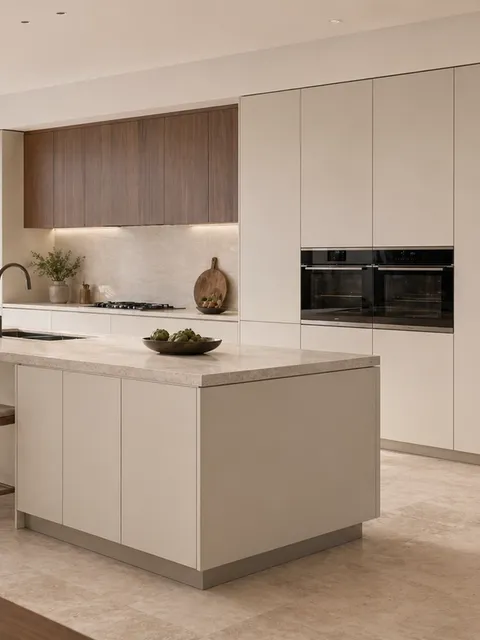
Fadior can support future technology by keeping the permanent room base clear: 304 stainless cabinet bodies, documented finishes, serviceable appliance bays, and practical storage zones. That gives buyers room to adopt connected features later.
When should a buyer ignore an AI kitchen trend?
Ignore the trend when it does not solve a household routine, requires a fixed device that may age quickly, or makes the room harder to maintain. The best test is whether the feature still makes sense if the app changes.


References
Authoritative sources cited in this article
- ISO/IEC 42001 AI management system
AI features should be governed with clear roles and records.
- Matter smart home standard
Interoperability matters more than one novelty feature.
Connectivity Standards Alliance Matter
- UL GREENGUARD certification
Low-emission claims should be documented.
- ASTM A240 specification
Flat stainless sheet references support material-basis discussions.
ASTM A240 flat product specification
- World Steel Association circular economy note
Durable material loops support long-life kitchen planning.
World Steel Association circular economy
Editorial transparency
Yuki Tanaka is a composite editorial persona maintained by Fadior Home's editorial team. Articles attributed to this byline are produced through an AI-assisted editorial workflow with human review, and represent the consolidated voice of multiple researchers and contributors.
Actually delivered
Real homes photographed after handover, not renders.
Ready to specify?