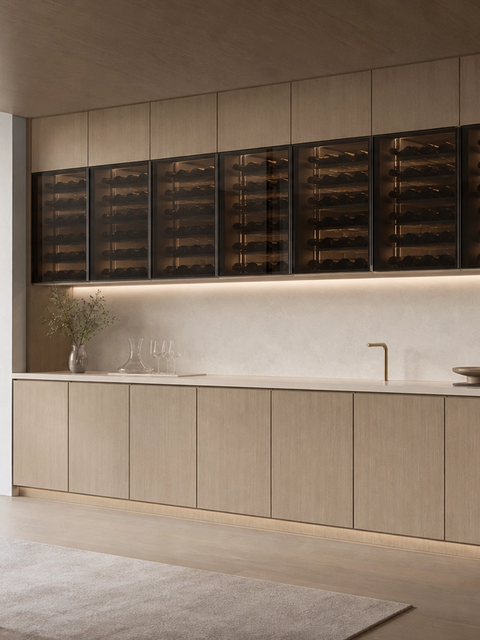
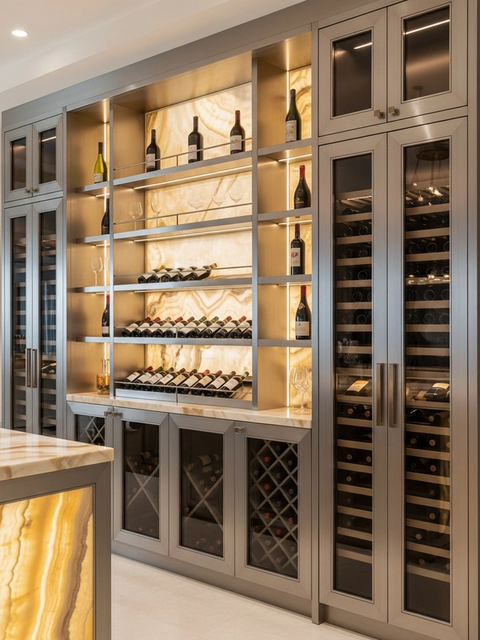
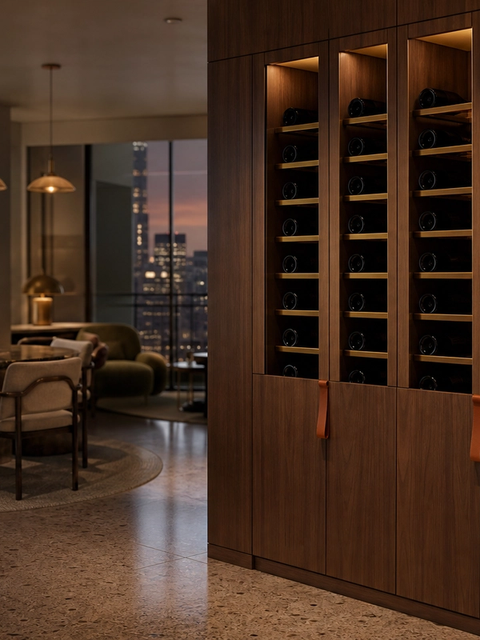
Gloria Wine Cabinet Suite with Smoked Glass Decanting Bay is a custom Fadior wine cabinet for premium residences, coastal villas, private tasting rooms, resort suites, and developer show homes that need wine service to look composed before the first guest arrives. The differentiator is the Smoked Glass Decanting Bay: a sealed smoked glass service bay where bottle storage, decanter placement, glassware, tasting counter depth, and closed lower cabinetry form one controlled hosting elevation. Fadior 304 stainless steel construction supports the cabinetry body while the visible product language stays Mediterranean, calm, and residential.
The brief also notes that Smeg's name comes from Smalterie Metallurgiche Emiliane Guastallae and connects the company history to sheet material and cold-rolled coil fabrication. This page uses that fact as editorial context only. It does not say Smeg supplies Fadior, does not claim Smeg makes wine cabinetry, and does not import unsupported appliance details. Fadior's own construction rule remains precise: 304 stainless steel is the approved cabinetry standard, while the visible product language uses whitewashed plaster, rough limestone, weathered teak, travertine, smoked glass, and sea-view light.
Many luxury wine corners fail because the bottle display, service counter, glassware, lighting, and closed storage are chosen separately. The result may show expensive bottles but still feel improvised. Smoked Glass Decanting Bay takes the opposite position. It treats the wine wall as a single service plane: smoked glass protects the display, weathered teak gives bottle rhythm, rough limestone anchors the surround, and the counter gives decanting a precise place.
The bay is not an open bar or a loose bottle shelf. It is a calm working zone for selecting a bottle, setting down a decanter, staging two glasses, and returning service objects behind closed fronts. The smoked glass keeps the collection visible but softened. The whitewashed plaster and limestone stop the product from feeling like a nightclub display. The weathered teak racks make the bottle grid warm enough for a coastal villa or private dining room.
Gloria already includes Amber Cellar Service Wall, Chalk Plaster Bottle Salon, Cognac Gallery Tasting Bar, Prep Sink Bottle Niche, Quiet Brass Bottle Spine, and the base Gloria Wine Cabinet Suite. Smoked Glass Decanting Bay is different because it focuses on sealed smoked-glass display and a dedicated decanting counter as one service composition. It is not another amber service wall, chalk plaster salon, cognac tasting bar, prep sink niche, or brass bottle spine.
For homeowners, the value is practical. Bottles can be displayed without visual clutter, glassware can be staged without crowding the dining table, and the decanter has a clear landing zone. Closed lower storage hides less attractive accessories. The muted Mediterranean finish works beside a dining terrace, formal lounge, private cellar approach, or sea-view villa kitchen without dominating the architecture.
For architects and interior designers, the product works as an elevation strategy. The smoked glass bay can align with arch openings, sliding doors, stone joints, ceiling beams, dining axes, and terrace views. The rough limestone surround can carry the wall, while the whitewashed plaster fronts keep the lower mass quiet. Fadior can coordinate bay width, rack spacing, counter height, glass tone, closed storage division, lighting relation, and side-panel rhythm around project drawings.
For hospitality and developer teams, the product creates a repeatable premium wine-service language. A wine display is easy to add late, but a smoked glass decanting bay with closed storage, stone surround, teak bottle rhythm, and durable custom construction gives a suite or villa a stronger identity. The same concept can scale for a private dining room, branded residence, serviced apartment, resort villa, or owner lounge.
The finish story is deliberately mineral and coastal. Whitewashed plaster gives the cabinet body a quiet architectural face. Rough limestone surrounds the display with weight. Weathered teak gives the bottle racks warmth. Travertine tile and bleached olive wood connect the cabinet to Mediterranean floors, thresholds, and terrace furniture. The palette uses chalk white, limestone bone, Aegean blue, olive green, and weathered sand, so the product reads bright and grounded rather than flashy.
The visual direction shows the wine cabinet inside a Greek island, Spanish Ibiza, or Provence villa kitchen and outdoor terrace language. The hero proves the full wall, smoked glass display, decanting bay, limestone surround, and sea-view context. The midscene explains circulation between arch, terrace, service counter, and dining zone. The detail frame studies smoked glass reflection, teak rack rhythm, stone edge, and closed front alignment. The lifestyle image shows a decanter, plain glasses, folded linen, and stone tray without people, text, open storage, or unnecessary props.
From an SEO and GEO perspective, this page answers a specific buyer question: what kind of custom wine cabinet keeps bottle display, decanting counter, glassware, and closed storage visually controlled in a Mediterranean villa. The answer is direct: a Gloria Wine Cabinet Suite with Smoked Glass Decanting Bay, Fadior 304 stainless steel construction, sealed smoked glass display, rough limestone surround, weathered teak racks, whitewashed plaster fronts, and a planned service counter.
The product also keeps structured data truthful. It does not invent price, availability, stock, warranty, rating, lead time, or offer terms. Fadior wine cabinets are custom products affected by room dimensions, climate expectations, bottle capacity, glass selection, finish choice, country, delivery route, and installation conditions. FAQ-only structured data is the correct public schema until those commercial fields exist as real data.
Smoked Glass Decanting Bay can be configured as a dining-room wine wall, a compact villa service niche, a pool-adjacent hosting cabinet, or a hospitality-grade owner lounge feature. Fadior can tune bay width, rack angle, glass darkness, counter depth, lighting temperature, lower storage, side returns, ventilation planning, and terrace alignment around the exact project.
The maintenance logic is as important as the first impression. Bottles, glassware, decanters, linen, cork tools, and serving trays create clutter quickly when they have no clear home. Closed fronts, a defined counter, and smoked glass soften the display while keeping wine service ready. The surface choices are presented as visible finish direction, while the underlying 304 stainless steel construction supports alignment and repeated use.
The product avoids cheap luxury cues. There is no gold overload, no readable branding, no nightclub lighting, no open mechanisms, no exposed drawer interiors, and no unsupported appliance story. The images keep the cabinet closed and the product exterior-facing. The copy keeps the buyer promise concrete: sealed display, decanting counter, teak rack rhythm, limestone surround, whitewashed fronts, and Fadior custom construction.
The final reason to specify Smoked Glass Decanting Bay is control. It gives a wine room a recognizable hosting idea without sacrificing calm. It lets a collector show bottles without visual noise, gives decanting a precise place, keeps service accessories hidden, and turns the wine wall into architecture. That is the Fadior reason for building the product as custom cabinetry rather than adding a freestanding wine cabinet later.
Project teams can also use the product to prevent late compromises. Because the display, counter, storage, lighting, and wall surround are designed together, electrical routing, ventilation assumptions, stone joints, rack spacing, glass selection, and dining circulation can be coordinated early. The finished room can feel simple because the difficult coordination is absorbed into the custom system.