
01 · Kitchens
Wet-and-dry kitchen systems
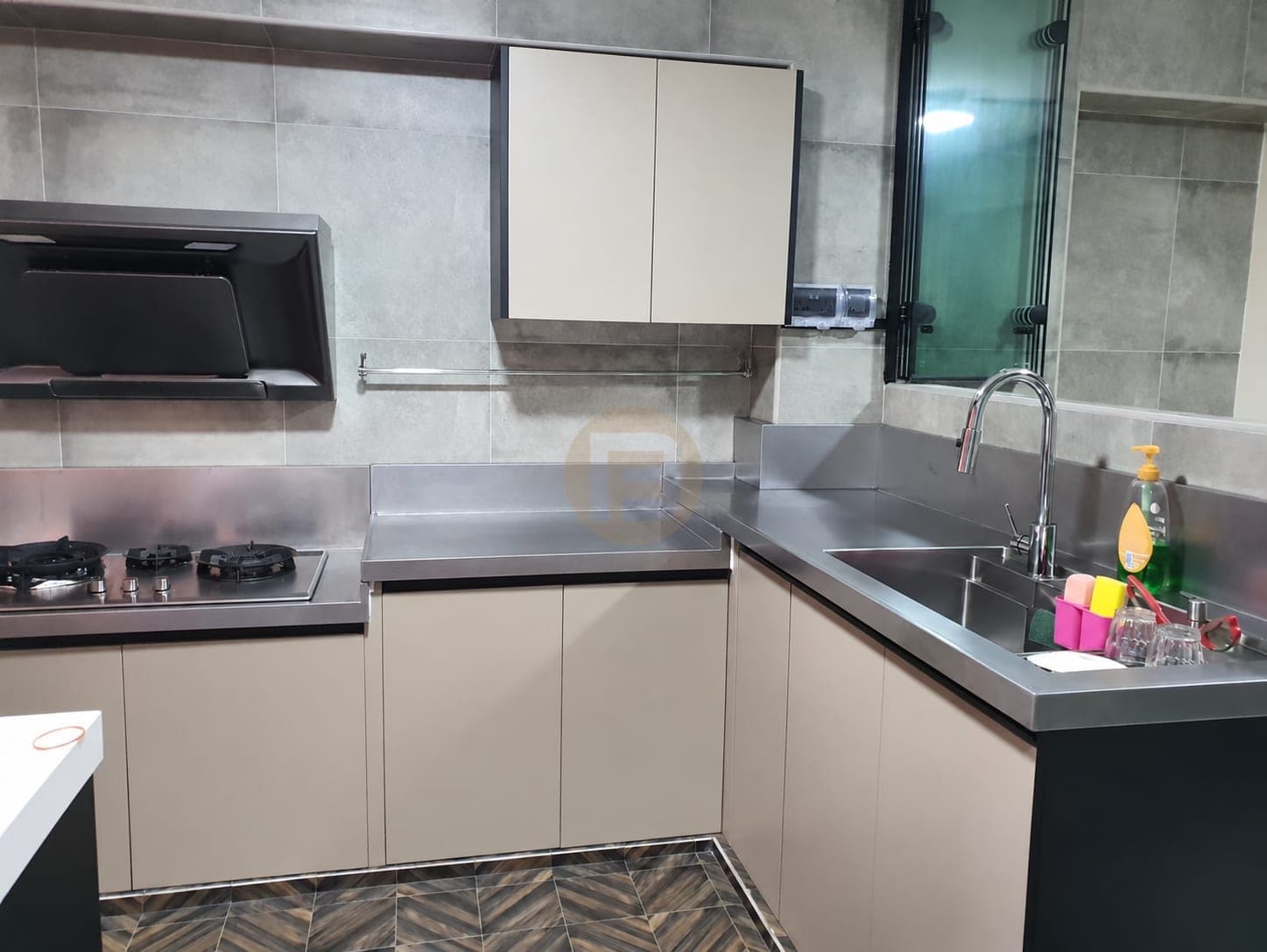
Coordinate food-grade 304 cabinet bodies for a cooking kitchen, dry pantry and scullery, with appliance openings, ventilation notes, drawer logic and a finish schedule for the approved drawings.
Fadior is a Foshan manufacturer of food-grade 304 stainless cabinetry for Singapore kitchens, wardrobes, vanities and outdoor entertaining spaces. The package is planned for tropical humidity, compact access and a clear handover to Singapore contractors.

Singapore projects live with year-round humidity commonly above 80 percent, intense rain, salt-laden coastal air and fast air-conditioning cycles. Those conditions make the cabinet-body material a practical design decision. A food-grade 304 stainless body does not swell like a timber-based board when an unprotected edge meets moisture, and it is not a food-contact or whole-system certification by itself. Doors, finishes, worktops, appliances, seals and plumbing interfaces still need their own specification. Fadior's role is to engineer and produce the cabinetry package in Foshan; the Singapore designer, builder or licensed contractor remains responsible for site conditions, local approvals and the final trade handover.
The same distinction matters in landed bungalows at Sentosa Cove, Bukit Timah and the East Coast, in high-rise condominiums and penthouses, and in HDB or condo homes that split cooking into wet and dry kitchens. A project can combine a main kitchen, scullery, utility room, wine storage, wardrobe, vanity and a sheltered BBQ terrace. The factory can coordinate metric room schedules, appliance openings, fronts, hardware and finish samples. The local team checks lift dimensions, corridor turns, fire doors, service risers, MCST rules and the exact access route before a production release.
Factory-direct supply is a defined commercial route rather than a promise of a turnkey Singapore build. Fadior reviews drawings, confirms the bill of materials, prepares labels and packing information, and produces the approved cabinet bodies. The importer and customs broker handle the Singapore Customs TradeNet permit and entry documents. A Singapore contractor coordinates 230V/50Hz Type G electrical work, PUB water rough-ins, waterproofing, ventilation, appliance commissioning and site tolerances. This separation lets a buyer compare a factory quotation with a local joinery quotation on the same scope.
For a boutique developer or a luxury homeowner, the value is control over material, proportion and sequence. A project brief can set one finish language across a dry kitchen and wet kitchen, then repeat the logic in a wardrobe or bathroom vanity. For a designer, the useful handover is a measured schedule with clear exclusions. For a builder, it is a room-by-room package that can be received in a constrained building. Every decision should identify who measures, who approves drawings, who arranges the permit, who receives the goods and who signs off the completed local trade work.
Coordinate food-grade 304 cabinet bodies for a cooking kitchen, dry pantry and scullery, with appliance openings, ventilation notes, drawer logic and a finish schedule for the approved drawings.
Develop room-by-room cabinetry for Sentosa Cove, Bukit Timah, East Coast and high-rise homes, with lift access, corridor turns and building management constraints visible before production.
Carry a consistent material story into walk-in wardrobes, bathroom vanities, laundry rooms and wine storage while each door, basin, worktop and hardware package keeps its own specification.
Plan an outdoor entertaining package around roof cover, drainage, ventilation, coastal exposure and maintenance. A local Singapore trade confirms the actual terrace conditions before release.
Use these documented specifications to compare a factory package, coordinate the local trades and set a realistic landed-cost conversation.
The useful comparison is between a defined factory scope and a local trade scope. Confirm the interfaces, access and taxes before treating two prices as equivalent.
The factory supplies an engineered cabinetry package. It does not promise Singapore site measurement, customs clearance, electrical or plumbing work, MCST or HDB approval, or local trade handover.
Local fit is proved by access, services and responsibility boundaries. Resolve these checks before a deposit and drawing release.
Monsoon rain, high relative humidity, air-conditioning condensation and frequent cleaning can expose weak board edges. A 304 stainless cabinet body avoids timber-board swelling in that part of the package, while seals, ventilation, worktops, wall protection and drainage remain design tasks. Termite pressure is also reduced because the body does not rely on timber board, but no material claim replaces a site-specific pest and maintenance plan.
Condo and HDB receiving can depend on lift-car dimensions, door width, corridor turns, fire doors, loading bays and booked time windows. Ask the local contractor to record these clearances in millimetres. Fadior can label and pack modules to the agreed schedule; the Singapore team confirms the route before production.
Singapore uses 230V/50Hz Type G electrical supply. The licensed electrician confirms appliance circuits, isolators and ventilation. The plumber coordinates PUB water rough-ins, traps, drainage and waterproofing. Fadior can reserve cabinet openings from approved appliance and service information, but licensed local trades control the live connections.
The importer or appointed broker checks the Singapore Customs TradeNet import permit, HS classification, and documents. Applicable Singapore import GST depends on customs valuation and current Singapore Customs rules confirmed by the broker. MCST or HDB renovation hours, lift protection, and contractor registration are separate building controls. Keep each approval with the project record.
Browse photographed homes to understand how kitchens, storage and finishes read in finished spaces, then ask for a comparable Singapore brief.



Use concept studies to discuss composition, lighting, storage logic and finish direction before drawings are approved.


Each step keeps commercial intent, factory coordination and Singapore responsibility visible. The sequence supports a quotation; it does not replace a licensed local project team.
Share the address zone, room list, wet and dry kitchen split, wardrobe or vanity scope, BBQ terrace ambition, appliance schedule, target date and the people responsible for the local trade work.
Measure lift cars, doorways, corridors, fire doors, loading access and receiving windows. Check HDB or MCST renovation hours, protection requirements and any contractor registration before a module schedule is fixed.
Review plans, elevations, appliance cut-outs, Type G electrical points, PUB water rough-ins, ventilation and worktop interfaces in millimetres. Mark what is design information and what the local contractor must verify.
Separate cabinet bodies, doors, worktops, hardware, packing, ocean freight, insurance, broker work, applicable GST estimates, and local trade handover. Request a room-by-room offer with exclusions.
Resolve labels, finish samples, hardware, clearances and inspection questions before deposit and drawing sign-off. The factory then releases the approved package to its production sequence.
The importer and broker manage TradeNet entry and delivery. The Singapore contractor checks the shipment, protects the building, completes utilities and verifies the final room against the approved schedule.
The right brief changes with the decision maker. These profiles keep the enquiry commercial and make the next document clear.
For a landed bungalow, penthouse or condominium renovation where humidity, storage, design continuity and building access all affect the decision.
For a custom residence or hospitality-style home where wet-and-dry kitchen planning, proportion and material evidence must survive a trade handover.
For repeatable apartments, villas or developer packages that need a controlled factory quotation and a documented receiving plan.
The market page frames cabinetry selection and responsibility boundaries. The separate Singapore guide covers Foshan sourcing, PSA routing, TradeNet documents, GST planning, receiving and local buyer questions. Confirm current rules with Singapore Customs, IRAS and your appointed broker.
These answers keep an imported cabinetry enquiry accurate when it enters a Singapore building project.
Fadior specifies food-grade 304 stainless steel for cabinet bodies. Doors, finishes, worktops, basins, appliances and service components have their own specifications. Confirm the bill of materials and contract before production.
Fadior has no Singapore showroom in this market specification. Buyers can visit the Foshan headquarters showroom or an authorised partner showroom in Greater Kuala Lumpur, Bangkok or Dubai when travel plans make that useful. A Singapore contractor can handle local site coordination.
The 304 cabinet body avoids timber-board swelling in that part of the package and reduces termite exposure to the body material. It does not make every door, finish, worktop, seal, appliance or wall waterproof. Ventilation, drainage, cleaning and local detailing still matter.
A consolidated FCL or LCL shipment can move from the Nansha, Shekou or Foshan area to the Port of Singapore, with an indicative sea transit of about 5–7 days before local handling. The importer and broker confirm the actual route, documents, insurance and delivery window.
The importer or appointed customs broker handles the Singapore Customs TradeNet import permit and entry documents. Applicable Singapore GST depends on the authority's customs valuation, current rules, and exact shipment mix. Always obtain a current calculation from a licensed Singapore customs broker for the actual consignment.
A licensed Singapore electrician and plumber coordinate 230V/50Hz Type G power, PUB water rough-ins, drainage, ventilation and waterproofing. Fadior can reserve openings from approved information, but live services and local compliance remain with the qualified Singapore trades.
Official Singapore Customs procedures for TradeNet permits, commercial invoices, packing lists, and freight clearance.
Official Singapore Customs guidance on Goods and Services Tax (GST) valuation and payment on imported cabinetry shipments.
Official trade reference summarizing Singapore import permits, customs documentation, and compliance steps.
Fadior Chencun smart factory scale, Salvagnini automated forming, 0.6 mm/1.2 mm steel architecture, and Shangpu verification.
Start with a defined scope
Prefer a direct message on WhatsApp?